
Introduction
The global macroeconomic and regulatory order has been reshaped since the 2008 financial crisis. Traditional commercial banks, squeezed by ever tighter capital adequacy and liquidity coverage rules under Basel III and its successors (Basel III/IV) as well as the Dodd-Frank Act and the Volcker Rule in the United States, were pushed toward caution and retreated one after another from high-risk, high-leverage credit markets. The real economy's demand for credit, however, did not disappear with them, least of all among sub-investment-grade mid-sized companies and restricted industries. That gap between credit supply and credit demand made fertile ground for the rapid growth of non-bank financial intermediation (NBFI). According to the latest global monitoring report from the Financial Stability Board (FSB), assets in the global non-bank financial sector grew 8.5% in 2023 to $256.8 trillion, or 49.1% of total global financial assets; the narrow measure of non-bank credit intermediation, the part capable of producing bank-run-like dynamics, hit a record $70.2 trillion in 2024.
Against that backdrop, the world's two largest economies each grew their own "shadow" credit system, shaped by their respective economic institutions, regulatory environment and market microstructure. China's main line of development was "shadow banking" designed to get around credit quota controls and to serve property developers and local government financing vehicles (LGFVs), building an intricate off-balance-sheet credit creation network with commercial banks as its implicit core. The United States, in the post-crisis era, incubated a "private credit" market led by direct lending, filling the financing vacuum left for mid-sized companies and heavily dependent on the private equity (PE) ecosystem. In their early years both systems were treated as innovations that widened corporate financing channels and improved the allocation of financial resources. As they swelled without discipline and grew structurally more complex, their built-in systemic fragilities came fully into view.
China's and America's non-bank credit systems differ sharply in geography, regulatory architecture, underlying asset types and exit mechanisms. Look at the underlying logic of the financial engineering and the transmission of macro risk, though, and today's US private credit market shows a striking historical symmetry with Chinese shadow banking on the eve of the 2017 crackdown. The symmetry shows up in the downward drift of funding sources toward retail investors with little capacity to absorb risk, in the quiet deterioration of underlying asset quality through a downturn, and in the deepening, tangled interconnectedness with the balance sheets of traditional commercial banks. The "gating crisis" that swept several flagship Wall Street private credit funds in the first quarter of 2026 punctured the illusion of the so-called "illiquidity premium" of evergreen funds, and announced that systemic risk had arrived in substance.
Drawing on detailed macro data, company-level restructuring cases and the latest regulatory developments, this piece traces the historical path and current state of Chinese shadow banking, dissects the rise and the structural fragility of US private credit, compares the two along several dimensions, assesses what these two models of non-bank credit intermediation threaten for financial stability in both countries and globally, and proposes macroprudential policy responses.
I. The Internal Logic and Historical Path of Chinese Shadow Banking
The rise and evolution of Chinese shadow banking is rooted in China's own gradualist financial reform process and its macroeconomic policy cycles. To understand its size and its structural complexity, you first have to be clear about what makes it different from Western shadow banking.
1.1 Defining the Size and the Cyclical Evolution of the Macro Structure
Academics and regulators have long disagreed over broad and narrow definitions of Chinese shadow banking. The FSB defines shadow banking loosely as "credit intermediation involving entities and activities outside the regular banking system," while the People's Bank of China (PBOC) has tried to apply a narrower standard better suited to Chinese conditions. Research and estimates put broad Chinese shadow banking at a peak of roughly RMB 67.03 trillion, while the narrow measure, strictly defined as involving maturity transformation, liquidity transformation and leverage without direct supervision, runs between RMB 10.3 trillion and RMB 21.9 trillion.
Before the China Banking Regulatory Commission (CBRC) launched its joint supervisory campaign code-named "334" in 2017 (a sweeping inspection targeting "three violations, three arbitrages and four improprieties") and before the landmark Guiding Opinions on Regulating the Asset Management Business of Financial Institutions (the "new asset management rules," NRAM) took effect in 2018, Chinese shadow banking had gone through a decade of fast and undisciplined expansion. Moody's data show that in 2013, shadow-banking-like products such as trust loans, entrusted loans and bankers' acceptances accounted for 30% of that year's new total social financing, a historical high.
Into 2024 and 2025, as Beijing shifted its policy weight toward "stabilizing growth" and eased monetary policy to cope with a persistently weak property market and geopolitical risk (in the first quarter of 2025, exporters front-loading shipments ahead of tariffs drove 5.4% GDP growth, yet domestic credit demand stayed soft), shadow banking assets staged a mild rebound after years of forced contraction. Broad shadow banking assets went from RMB 50.3 trillion in 2022 and RMB 49.0 trillion in 2023 back up modestly to RMB 53.3 trillion in 2024.
This rebound does not mean systemic risk has slipped its leash again; it is the result of a structural shift. Successive rate cuts by the central bank pushed commercial banks' net interest margin (NIM) down to around 1.5% by mid-2024, and the low-rate environment sent money hunting for higher-yielding assets. Wealth management products (WMPs) and trust loans became the main drivers of the modest recovery in shadow banking assets. Even so, relative to the 2021 peak and to the period when the sector topped 51.5% of nominal GDP, the current level remains manageable and still inside a long contractionary channel.
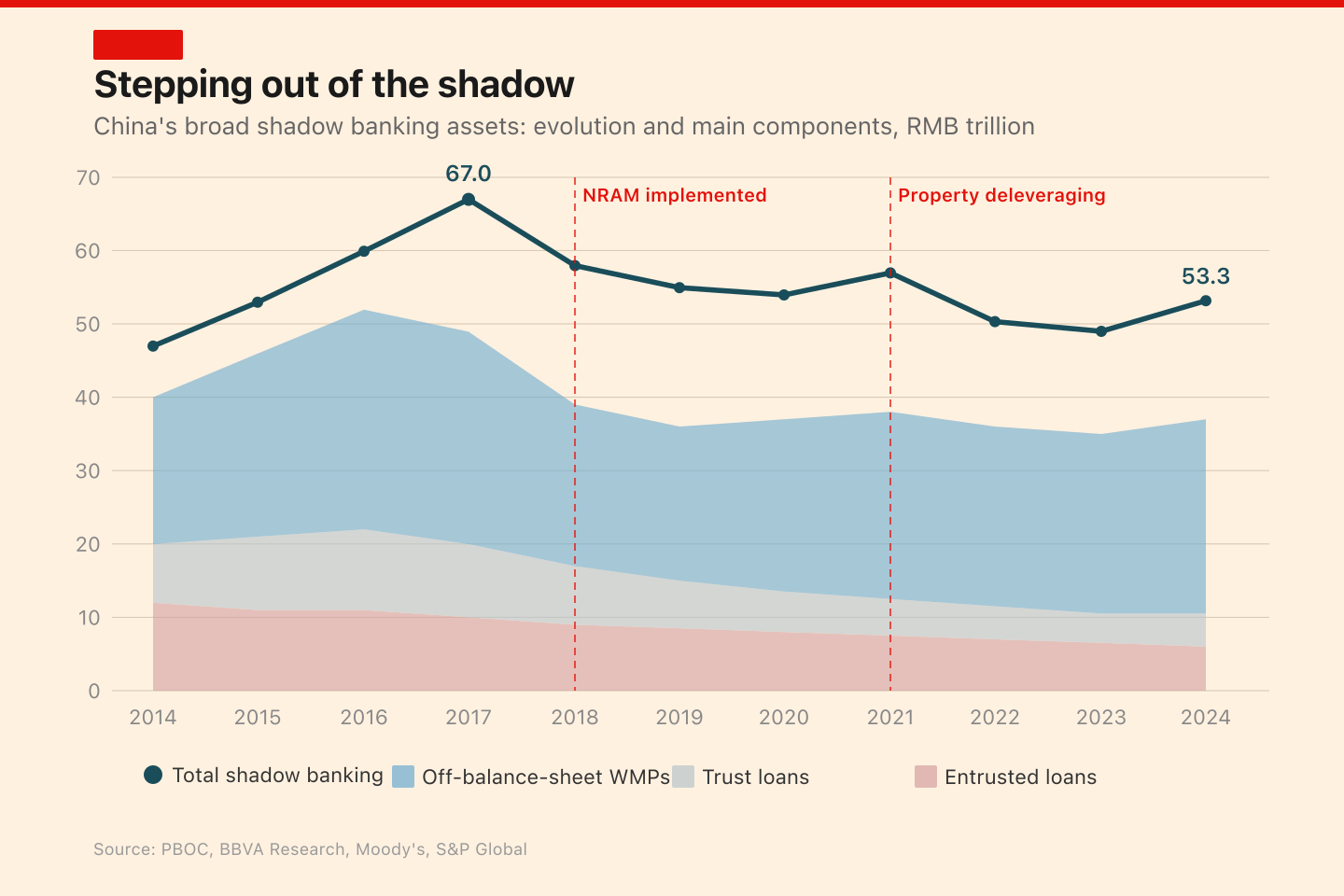 Chart: broad shadow banking assets in China and their main components (2014-2024), in trillions of RMB. Total assets peaked at RMB 67 trillion in 2017, then declined steadily under the new asset management rules and property deleveraging, with a weak uptick at the end of the period (from RMB 49.0 trillion back to RMB 53.3 trillion in 2023-2024).
1.2 The Core Components and the "Banks' Shadow" Character
Chinese shadow banking works differently from the Western version, which transfers credit risk through complex securitization and special purpose vehicles (SPVs). In China it is really the "banks' shadow." In the Chinese financial system, traditional bank credit faces strict limits on where it can flow (bans on lending to industries with excess capacity, to property, and to local government financing vehicles) as well as loan-to-deposit ratio and capital adequacy tests. To get around these constraints, commercial banks became the actual organizers of the shadow banking ecosystem, creating credit money through off-balance-sheet items.
Chinese shadow banking has three core components.
Entrusted loans. These are one of the largest pieces of China's non-standard credit assets. Entrusted loans come in affiliated and non-affiliated varieties. Their core logic is regulatory arbitrage: an entity with privileged access to cheap credit (usually a large state-owned enterprise) borrows cheaply from a bank, does not invest the money in its own operations, and instead acts as the funding provider, using a commercial bank as intermediary (which collects only a fee and bears no nominal credit risk) to on-lend at rates far above the official benchmark to small and mid-sized companies or property developers that cannot borrow from banks directly. This drives up the overall cost of funding for the real economy and lets credit risk circulate through the system out of sight.
Trust loans and bank-trust cooperation. Chinese trust companies hold a unique licensing advantage spanning money markets, capital markets and direct industrial investment. At the peak, roughly 70% of trust funding came from banks. Commercial banks channelled pools of money raised through wealth management products into trust plans (the bank-trust cooperation channel) and moved assets off their balance sheets. Trust companies faced far less scrutiny over where they invested, so they could push this money without friction into high-risk, high-yield areas such as property projects and LGFVs.
Wealth management products (WMPs). WMPs played a crucial role as "quasi-deposits" on the liability side of the shadow banking balance sheet. Commercial banks sold WMPs to retail customers and high-net-worth individuals, and because early products were not managed on a net asset value basis, they typically promised fixed returns far above the official benchmark (when the official benchmark deposit rate was only 1.5%, the average annualized WMP yield could reach 4.66%). Paying up for deposits this way pulled in an enormous share of Chinese household savings and converted it into ammunition for expansion on the asset side of shadow banking.
| Shadow banking component | Funding source | Core channel / mechanism | Where the money went | Core risk characteristics |
|---|---|---|---|---|
| Entrusted loans | Surplus cash at large SOEs, firms with privileged access to cheap credit | Commercial bank acts as trustee and disburses the loan | Property, restricted industries, small and micro enterprises | Credit risk transferred out of sight, pushes up real-economy funding costs |
| Trust loans | Bank WMP funding pools (70%), some high-net-worth retail money | Bank-trust cooperation channel (evades limits on where credit may flow) | Developers buying land, local government financing vehicles (LGFVs) | Severe maturity mismatch, underlying assets illiquid and opaquely valued |
| Wealth management products (WMPs) | Retail customers (household savings), interbank money | Off-balance-sheet funding pools, maturity mismatch, rolling issuance | Bonds, non-standard credit assets | Expectation of implicit guarantee creates moral hazard, easily turns Ponzi-like |
Table 1: microstructure and risk characteristics of the core components of Chinese shadow banking
1.3 Deep Entanglement with Property and LGFVs, and the Risk Feedback Loop
On the asset side, Chinese shadow banking concentrated heavily on areas traditional credit could not reach directly, above all property development and local infrastructure. Before the "housing is for living in, not for speculation" policy and before the debt crises at leading developers such as Evergrande, WMPs and trust loans were the key supply line keeping developers highly levered as they bought land and ran their "high-turnover" model.
Because these products were usually distributed by China's large state-owned commercial banks, retail investors held a deeply entrenched expectation of an implicit guarantee. They wrongly assumed that if the underlying assets defaulted, the bank or the local government would ultimately step in with money to keep things calm. This institutional trust, which was an illusion, created a dangerous positive feedback loop: enormous sums flowed into shadow banking, supporting developers as they added more leverage, which pushed land and house prices higher still, while roughly 70% of urban Chinese household wealth was itself tied to property.
At the same time LGFVs, set up by local governments to get around direct borrowing limits and fiscal deficit constraints, became shadow banking's other super-client. LGFVs typically pledged local land use rights as collateral and issued large volumes of LGFV bonds and non-standard assets (such as trust loans) through the shadow banking system to fund infrastructure. Regional blow-ups in early 2024 made the fragility of this arrangement plain: one shadow lender in Hangzhou failed to pay $2.8 billion of principal and interest to WMP investors, its underlying assets being defaulted commercial paper and developer loans from more than a dozen borrowers.
Through 2024 and 2025, with local finances strained and land sale revenue sharply down, the central government had to push ahead steadily with a hidden local debt swap program, providing trillions of RMB in refinancing quota to relieve near-term default pressure. Yet according to assessments by the Institute of International Finance (IIF) and others, the banking system's total on- and off-balance-sheet exposure to LGFVs remains extremely large. This entanglement means any deep adjustment in the property market transmits straight to local public finances and, through broken LGFV cash flows, sets off widespread default risk in the assets underlying shadow banking.
1.4 Rebuilding Macroprudential Regulation and Establishing a Durable Framework
Recognizing the systemic threat from off-balance-sheet leverage, Chinese regulators put the prevention of systemic financial risk at the center of policy from late 2016 and then ran a dense series of joint supervisory campaigns through 2017. The new asset management rules of 2018 fundamentally reshaped the Chinese shadow banking ecosystem.
The rebuild rested on three pillars.
Break the implicit guarantee and move to net asset value. Funding pools were banned outright, and all asset management products were required to be managed on a net asset value basis (mark-to-market), so investors genuinely bore the credit and market risk of the underlying assets.
Set up wealth management subsidiaries to ring-fence risk. Commercial banks were required to spin off their off-balance-sheet wealth management business into separately incorporated wealth management companies, building a solid physical and legal firewall between the parent bank's balance sheet and high-risk off-balance-sheet assets.
Shrink non-standard assets and cap leverage. Strict limits were placed on how much of a wealth management product could sit in non-standard credit assets, and a uniform leverage ceiling was set (no more than 200% of net assets).
By 2024 and 2025, after years of painful workout, the underlying asset mix of Chinese shadow banking had changed fundamentally. The vast majority of WMPs now hold low- to medium-risk standardized corporate and rate bonds, and the share of non-standard assets has shrunk sharply. Chinese banks face falling profitability, compressed net interest margins and pressure to raise capital (including the total loss-absorbing capacity, or TLAC, rules being phased in through 2025), and smaller banks have leaned somewhat more on interbank funding in the low-rate environment. Even so, the interconnectedness between the shadow banking system as a whole and traditional commercial banks has been brought firmly under control.
II. The Surge, Internal Evolution and Structural Fragility of US Private Credit
If the early expansion of Chinese shadow banking was regulatory arbitrage set off from above by credit quotas and a rigid interest rate system, then the boom in US private credit is the direct product of traditional commercial banks withdrawing from the high-leverage lending market for mid-sized companies under the combined weight of Dodd-Frank, the Volcker Rule and Basel after the 2008 subprime crisis. The vacuum the banks left behind was quickly filled by non-bank financial institutions that were more flexible and not bound by strict capital adequacy rules.
2.1 Exponential Growth and the Evolution of Strategy
Private credit (also private debt) generally means loans made directly by non-bank entities (private debt funds, business development companies or BDCs, and others) to middle-market companies, loans that do not trade in public markets. Over the past fifteen years this asset class has grown at a remarkable exponential rate.
According to the International Monetary Fund (IMF) and Preqin, global private credit assets, including deployed capital and undrawn commitments, exceeded $2.1 trillion by 2023, roughly ten times the 2009 figure. The US market accounts for about three quarters of that, some $1.34 trillion to $1.57 trillion. That scale is already closing on the traditional US high-yield bond and broadly syndicated loan markets, and the industry optimistically projects that with new strategies such as asset-backed finance (ABF), the potential addressable market could reach $5 trillion to $30 trillion by 2029.
On strategy, direct lending dominates without serious challenge. Fundraising data for the full year 2024 show direct lending absorbing 77.4% of new capital (roughly $152.7 billion), far ahead of special situations or distressed debt. The appeal is that it usually sits at the most senior point in a company's capital structure (senior-secured) and uses floating rates, which gave investors excellent real-time rate protection and inflation-resistant income through the Fed's hiking cycle.
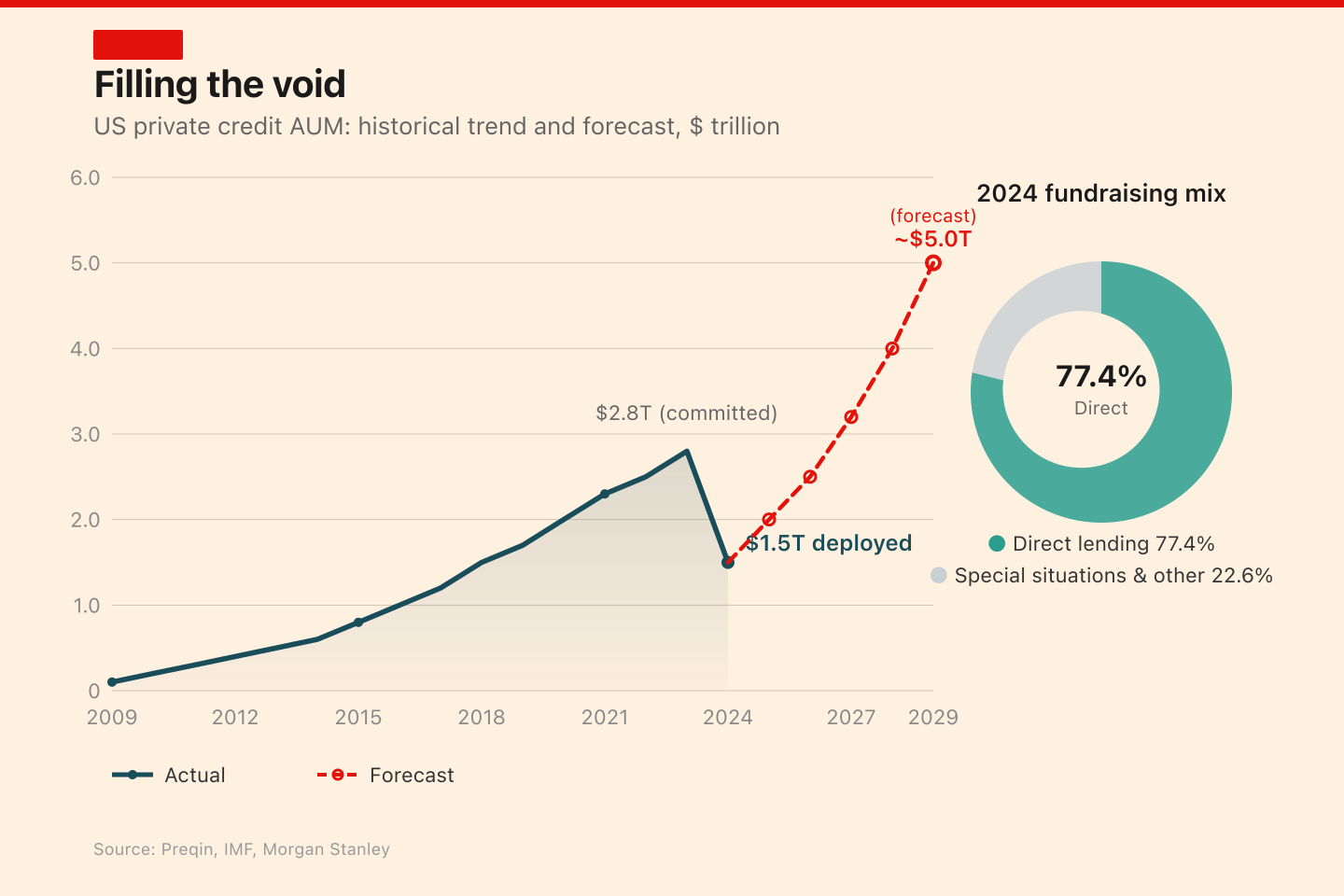 Chart: US private credit assets under management, history and forecast (in trillions of dollars). From nearly zero in 2009 to roughly $1.5 trillion deployed in 2024, with the industry forecasting a jump to nearly $5 trillion by 2029. The donut on the right shows the 2024 breakdown of new private credit fundraising by strategy: direct lending at 77.4%.
2.2 The Retail Push on the Funding Side and the BDC Super-Pump
Early on, the US private credit funding pool was almost entirely institutional, dominated by investors with long-duration liabilities such as public pension funds, sovereign wealth funds, insurers and family offices. A 2024 KPMG survey put institutional capital at roughly 80%. Long institutional holding periods meaningfully reduced the risk of mass redemptions and forced asset sales in stressed markets.
As competition intensified and institutional allocation pools approached saturation, and as the high-rate environment blocked M&A exits in private equity and pushed distributions to paid-in capital (DPI) for limited partners to record lows, the large managers (Blackstone, Apollo, Blue Owl, Carlyle and others) turned wholesale to retail investors and high-net-worth individuals in the private wealth channel.
Business development companies (BDCs) became the super-pump of this retailization. BDCs, particularly non-traded semi-liquid structures aimed at individual investors (Blackstone's giant BCRED, and BREIT on the real estate side), pulled in individual money at furious speed through private banking channels. Retail investors were drawn by the advertised stable annualized yields of 9% to 10%, the floating-rate advantage, and the artificially low volatility that comes from having no mark-to-market mechanism.
Packaging deeply illiquid middle-market corporate loans and promising them to retail investors with much higher liquidity expectations (typically allowing quarterly redemption requests of up to 5% of fund shares) planted a serious duration mismatch at the foundation. It was dancing on a powder keg, and it set up the systemic run that followed.
2.3 Quiet Deterioration in Asset Quality and the Spread of Zombie Companies
The boom in US private credit produced an oversupply of capital. More than 500 new private credit funds have appeared since 2008, leaving the industry sitting on nearly half a trillion dollars of dry powder, money raised but not yet deployed. In this intensely crowded competition of money chasing scarce quality assets, lenders desperate to put capital to work and earn management fees kept conceding on loan terms.
That produced two systemically dangerous trends.
The first is the spread of covenant-lite loans. In traditional bank lending, creditors set strict financial maintenance tests (minimum interest coverage, maximum leverage), and a breach let the bank step in and restructure early. In today's private credit market, the overwhelming majority of new loans have dropped virtually all meaningful financial protections, so creditors have lost the right to intervene when a borrower's finances start to deteriorate. That is the breeding ground for what the market calls creditor-on-creditor violence.
The second is abuse of payment-in-kind (PIK) instruments and the mass production of zombie companies. In the stagflationary environment from 2022 to 2024, when aggressive Fed hikes kept long rates high, large numbers of PE-owned portfolio companies on floating-rate loans faced doubled interest expense and severely squeezed operating margins. To paper over the coming wave of defaults, private credit funds and PE sponsors made wide use of liability management exercises (LMEs), of which PIK is the most typical. PIK lets a borrower with no cash convert current interest due into additional principal and defer payment. On paper this miraculously avoids technical default and protects the fund's current valuation, but mechanically it drives the loan-to-value ratio much higher and makes the debt burden compound exponentially.
This extend-and-pretend approach has manufactured a large population of zombie companies. A zombie company is usually defined as one more than ten years old whose earnings before interest and taxes (EBIT) have failed to cover its interest expense for three consecutive years, surviving only by rolling its debt cheaply. Bloomberg estimated that as of the end of 2025 there were 639 zombie companies among publicly traded US firms in the Russell 3000 alone, the most since early 2022, with broader estimates suggesting roughly 2,000 such companies nationwide. In the more opaque private market, assets managed by US zombie funds (past-term PE and credit funds holding large stocks of assets they cannot exit) surged to a record $441 billion in 2024, and 77% of the capital in funds raised in 2014 was still unrealized in year ten.
2.4 The Extreme Case: Pluralsight's Restructuring and Creditor-on-Creditor Violence
When a zombie company's cash flow dries up to the point that even PIK will not hold, the brutal restructuring of the underlying asset begins. The debt restructuring of the technology education platform Pluralsight, running from the second half of 2024 into 2025, is widely seen in finance as the canary in the coal mine for liability management exercises in private credit getting out of hand.
What happened. Pluralsight was controlled by the well-known private equity firm Vista Equity Partners. Through the aggressive hiking cycle, interest expense on Pluralsight's roughly $1.5 billion private credit term loan spiked, the company could not pay, and Vista found the equity it had put in wiped out entirely. To avoid an immediate bankruptcy filing that would cost it control outright, Vista engineered an asset carve-out that stunned Wall Street.
Vista injected $50 million of loan money into a newly formed Pluralsight non-guarantor subsidiary that sat outside the existing private loan agreement. In exchange, Pluralsight moved its most valuable asset, its intellectual property, out of the entity securing the $1.5 billion term loan and pledged it to the new subsidiary. The freshly injected $50 million then flowed back up to the parent, where it happened to be exactly what was needed to pay interest on that same $1.5 billion loan.
Why it mattered. On the surface this got Pluralsight past an interest payment default, but the $50 million of new debt was in substance a brutal expropriation of the existing $1.5 billion of private creditors. Moving the core collateral, the IP, sharply reduced recovery rates for the original first-lien lenders in an eventual bankruptcy. This extreme LME did not ultimately turn Pluralsight around; Vista gave up the company a few months later and handed it to a creditor-led restructuring with a $120 million capital injection that cut about $1.2 billion of debt. But the case laid bare the reality that under the permissive terms of private credit, a PE sponsor can exploit legal loopholes to harm lenders more or less at will. Data from the rating agency KBRA show that seven BDCs holding Pluralsight loans had to write their positions down substantially. This phenomenon, which the industry calls lender-on-lender violence, badly shook the core narrative that senior-secured private credit assets are safe.
| Feature | Pluralsight restructuring | What it tells the private credit industry |
|---|---|---|
| Initial debt | About $1.5 billion private term loan | Buyout leverage too high, extreme sensitivity to rates |
| Trigger | Fed hikes spiked floating interest costs, cash flow dried up | Macro reversal broke the underwriting model the PE sponsor originally assumed |
| Liability management (LME) | PE owner injected $50 million into a non-guarantor affiliate and moved core IP as collateral | Asset stripping through covenant-lite loopholes, harming senior creditors |
| Outcome | $1.2 billion of debt cut, PE gave up equity, lenders took over | Apparent soundness on paper masked very low actual recoveries; when default comes, losses are severe |
Table 2: a close reading of a typical US private credit default and liability management exercise (LME)
2.5 The Liquidity Illusion Breaks: Wall Street's 2026 Gating Crisis
Quietly deteriorating asset quality collided with the semi-liquid product structure, and in late 2025 and early 2026 it set off the private credit and real estate fund gating crisis that shook Wall Street.
A long stretch of high rates put pressure on underlying valuations, and retail investors grew suspicious of book yields propped up by PIK, so demands for cash came all at once. Since middle-market loans simply cannot be dumped quickly in a secondary market, fund managers had nothing beyond a small pile of cash and their bank credit lines, and were forced to pull down the gates.
The first quarter of 2026 became a liquidity slaughter.
Blue Owl Capital. On February 19, Blue Owl took the unprecedented step of permanently closing the redemption window on its $160 million OBDC II fund, scrapping the quarterly liquidity promise retail investors depended on and offering only quarterly capital returns at management's discretion.
BlackRock. In March, the world's largest asset manager imposed redemption limits on its $26 billion HPS lending fund. Facing redemption requests of 9.3% (about $1.2 billion), BlackRock cited its 5% quarterly outflow cap and met only half of client demand.
Morgan Stanley. Its North Haven Private Income fund received redemption requests worth 10.9% of assets and ultimately returned just $169 million to clients, constrained by the same 5% withdrawal cap.
Blackstone. BCRED, at $82.5 billion the world's largest private credit fund, faced a record $3.8 billion of quarterly redemptions (7.9% of assets). To avoid formally gating the way its real estate fund BREIT did in 2022, which would have triggered a wider collapse in confidence, Blackstone resorted to extreme measures, committing $400 million of its own corporate capital plus a pool of executives' personal money to buy the orders outright and meet redemptions in full.
This chain of runs wiped roughly $265 billion off the market value of private equity and credit managers in a matter of months (Blue Owl fell 67% from its high, Blackstone 46%, Apollo 41%), and it punctured the illusion of the so-called illiquidity premium in evergreen funds. Research from EDHEC Business School in France found that across 16 evergreen funds, as much as 70% of total returns were unrealized gains, and in some newer funds the share approached 90%. When liquidity was genuinely tested, a model resting entirely on managers marking their own book collapsed.
III. Comparing Non-Bank Credit Intermediation in China and the US: Structural Symmetry Across Time and Space
China and the United States sit in entirely different financial systems, ownership structures and stages of development. Look carefully, though, at Chinese shadow banking on the eve of the 2017 crackdown and at US private credit in its current crisis, and the underlying financial engineering and the way risk accumulated show a striking symmetry across time and space, even as the political economy of how the risk gets handled differs fundamentally.
3.1 Same Arbitrage, Different Motives
Mechanically, the non-bank credit booms in both countries are textbook regulatory arbitrage, moving credit activity off the heavily regulated balance sheets of traditional commercial banks to dodge various constraints.
China's motive: getting past credit quotas and prohibited sectors. The arbitrage motive for Chinese commercial banks came mainly from the asset side. Regulators had long imposed strict macro controls and credit quotas on property, industries with excess capacity, and LGFVs. The core purpose of shadow banking (bank-trust cooperation, entrusted loans) was to build an unobstructed and discreet channel carrying abundant liquidity with nowhere else to go into precisely those parts of the real economy that were fenced off but willing to pay outsized interest.
America's motive: avoiding capital requirements and chasing absolute yield. In the US, the arbitrage motive came mainly from the capital penalty regulators attached to risk weights. Under Basel and the Volcker Rule, a traditional bank writing leveraged loans had to hold very expensive capital against them, so banks chose to exit. Private credit funds face no such constraints, which apply to deposit-taking institutions, and using very high fund-level leverage they absorbed the middle-market and buyout credit banks would no longer touch.
3.2 How Each System Interconnects with the Core Banking System
Neither China's WMPs nor America's BDCs ever truly stood apart from traditional commercial banks. On the contrary, they formed extremely complex and tangled interconnectedness on both the funding and the liquidity side. These implicit links turned banks from front-of-house credit originators into behind-the-scenes system funders, and they paved the way for contagion across the whole financial system.
The Chinese mechanism: off-balance-sheet endorsement and the interbank carousel. Before the new asset management rules, Chinese commercial banks were the largest public-facing distribution point for shadow banking products (wealth management products), and at the same time the largest providers of funding. Smaller banks borrowed from large banks through negotiable certificates of deposit (NCDs) and turned around to invest in non-standard wealth management or trust products issued by other institutions. Because the products were sold at bank branches, banks lent their own sovereign-backed credibility to shadow banking, creating a de facto obligation to make investors whole.
The American mechanism: double exposure, backup credit lines and asset-backed finance (ABF). Federal Reserve monitoring data show US bank loan commitments to private credit vehicles rising in a straight line from roughly $8 billion in the first quarter of 2013 to about $95 billion at the end of 2024, with $56 billion actually drawn. When the assets a private credit fund holds deteriorate or redemption pressure hits, the fund will not hesitate to draw its revolving credit lines from commercial banks to pay cash out to investors, consuming the banking system's liquidity buffers directly. More serious still, large private credit managers increasingly sign forward-flow agreements with traditional banks. Under these, the bank uses its network to originate large volumes of consumer or auto loans and then sells them in bulk as asset-backed finance (ABF) to private credit funds. That ties banks and private credit together on both the asset and the liability side in an extremely dangerous way.
| Dimension | Chinese shadow banking (typical, pre-2017 crackdown) | US private credit (typical, 2024-2026) |
|---|---|---|
| Main deposit-gathering channel | Off-balance-sheet bank wealth management products (WMPs) | Business development companies (BDCs), semi-liquid evergreen funds |
| Degree of retailization | Very high, absorbing large volumes of unsophisticated household savings | Rising fast, full pivot to private wealth once institutional demand topped out |
| Core underlying assets | Property developer loans, non-standard LGFV credit | Leveraged buyout debt (LBOs), PE-owned mid-sized software and services firms |
| How defaults were hidden | Funding pools rolling new money to repay old, implicit guarantees | Payment-in-kind (PIK) capitalizing interest, liability management exercises (LMEs) |
| Hidden links to the banking system | Interbank churn, off-balance-sheet backstops, bank-trust channels | Revolving credit lines topping up cash, ABF forward purchase agreements |
Table 3: core characteristics of Chinese and US non-bank credit intermediation, and their structural common ancestry across time and space
3.3 The Retail Trap, Repeated: From WMP to BDC
The current frenzy to push US private credit down into retail wealth management is a precise and unsettling replay of the history of Chinese WMPs.
At the height of Chinese shadow banking, WMPs gathered countless retail investors chasing safe high yields across bank counters into enormous funding pools. Those pools carried severe maturity mismatch, using three- to six-month retail money to fund property and infrastructure projects lasting several years. As long as money kept flowing in, the game continued; once liquidity tightened, the Ponzi character surfaced, and in the end the Chinese government had to burst the bubble by force with the new asset management rules.
In the US, once traditional institutional investors such as sovereign wealth funds and pensions stopped adding because they were short of distribution cash flow, the BDCs and REITs that Wall Street asset managers packaged so carefully became the instrument for harvesting retail money through private banking and 401(k) channels. Retail investors have very little ability to recognize the risk. Once they discover in a downturn that their actual returns have been manipulated by the paper wealth of PIK, or that they cannot get their money out at all as in 2026, this forced retailization of illiquid assets will inevitably produce a broad consumer protection crisis and mass litigation panic.
3.4 Underlying Differences in Exit, Clearing and Crisis Intervention
Faced with a non-bank credit crisis, the two countries respond from different foundations in political economy.
The Chinese model: forceful administrative intervention and orderly clearing. Chinese shadow banking is deeply embedded in a financial system dominated by state credit. Once the leadership judged that accumulating risk might threaten national financial security, the government could mobilize administratively in ways no other system can match. Through the top-down "334" inspections, a firm severing of the umbilical cord between banks and off-balance-sheet non-standard assets, special refinancing bonds issued by local governments to work down debt, and pressure on asset management companies (AMCs) to accelerate disposals of bad assets, China spent several years deliberately squeezing the shadow banking tumor out. The process brought short-term economic pain and a credit crunch, but it avoided a systemic collapse on the scale of 2008.
The American model: passive market struggle and regulatory delay. The US private credit market depends heavily on market exits, through M&A or public market IPOs. With the M&A market frozen and the exit pipeline blocked, US private equity and credit funds cannot sell assets for cash, so they have invented synthetic liquidity tools in volume: continuation funds, net asset value (NAV) financing, an internal game of passing assets from one hand to the other to keep up appearances. More worrying is the clear regulatory delay from US federal agencies. The Securities and Exchange Commission's attempt to strengthen private fund disclosure and valuation review was struck down outright by a federal court in 2024 as exceeding its authority, leaving regulators nearly powerless in the face of a systemic crisis in the making.
IV. Systemic Threats to Both Financial Systems and the Macro Transmission Channels
As the IMF has warned, the danger of non-bank financial intermediation often lies not in its absolute size (still small relative to the whole fixed income market) but in how opaque its structures are and in its capacity to become deeply entangled with systemically important financial institutions (SIFIs) through unmeasured leverage. When the macro environment shifts sharply, that fragility spreads across markets fast and turns into a systemic crisis.
4.1 China: The "Death Triangle" of Property, Local Debt and Small Banks
In China, forceful regulation has removed the immediate risk of shadow banking spinning out of control, but the historical burden is heavy, and the residual threat to the financial system, particularly to regional financial ecosystems, shows up mainly in the fragile feedback loop between property, local debt and small banks. As AXA Investment noted in assessing Chinese macro risk, "the intricate interconnectedness between financial institutions, the property sector, and local and central governments creates a fragile environment. In this context, even minor disruptions could trigger a chain reaction that destabilizes the entire banking system."
The transmission runs as follows.
Collapsing collateral values and defaults on non-standard assets. A large share of Chinese shadow banking assets, and of traditional credit, relies on land use rights and commercial property as collateral. As property deleveraging deepened, stalled new home sales cut land sale revenue sharply and the underlying collateral was repriced. The high-interest non-standard debt that had been funnelled to developers through trust channels was the first to default.
Local fiscal strain and the risk of hidden debt blowing up. With land finance stalled, local government financing vehicles lost their main source of repayment. China's six large state-owned commercial banks can absorb losses well, but the thousands of city commercial banks and rural banks spread across provinces and cities often carry disproportionately large exposure to their local LGFVs and developers. These lower-tier institutions bear the brunt of surging bad debt.
Liquidity contagion in the interbank market. To hide bad loans and keep operating, small banks in fiscally strained regions have had to go along with LGFVs rolling or extending debt. That badly erodes bank capital buffers and net interest margins. When deposits leave or liquidity tightens, these banks have no choice but to turn more often to the interbank market for expensive short-term funding. That converts isolated regional credit risk into systemic liquidity contagion in short order.
The PBOC and the Ministry of Finance cut off acute panic by force, providing an RMB 1.4 trillion hidden debt swap facility and injecting capital directly to rebuild core capital. But the scars left on balance sheets have markedly reduced the capacity to create credit. Banks hoard credit and cannot transmit liquidity effectively to the parts of the real economy that actually need support, and the long shadow of this balance sheet recession is a deep obstacle to China achieving high-quality macroeconomic growth.
4.2 The US: A Negative Feedback Spiral Across Private Markets, Insurance and Banks, and a Valuation Collapse
Compared with China's real-economy risk driven by collateral depreciation, the systemic threat US private credit poses is a more modern one: a synthetic liquidity collapse spiral spanning several dimensions of capital markets.
The first layer of threat comes from the deep involvement of the life insurance industry and its asset mismatch. In recent years large US private equity firms (Apollo, KKR and others) have run what the industry calls the great insurance hunt, buying up life and annuity insurers in bulk. The core strategy is to use the long-dated, stable premium money policyholders provide, permanent capital, to buy large quantities of the firms' own private credit funds, collateralized loan obligations (CLOs) and asset-backed securities. Estimates put more than 20% of total US insurance industry assets already exposed to these high-risk, illiquid private assets. If a long stretch of high rates combines with a weak economy and zombie companies finally cannot pay even PIK interest, defaulting materially and at scale, these insurers' balance sheets will take heavy damage. Sharp rating downgrades would force insurers to raise capital, and could even trigger a run by policyholders, which is not without precedent in US financial history.
The second layer is nested leverage and the sudden detonation of traditional bank exposure. A typical US middle-market buyout financing often includes a broadly syndicated loan (BSL) underwritten and distributed by large commercial banks alongside senior or junior debt held by private credit funds. As the Pluralsight case shows, when a borrower faces an existential crisis and runs an asset-stripping LME, it is not only the private credit funds that take losses; the syndicated debt sitting on traditional bank books is hollowed out at the same time, creating double exposure. On top of that, when the 2026 gating crisis broke, private credit funds facing enormous withdrawal pressure inevitably drew down their standby revolving credit lines at commercial banks in full. That kind of institutional behavior resonating at the macro level, similar to the dash for cash in early 2020, drains precious liquidity out of the core banking system in an instant and forces the Fed to step in as lender of last resort once again.
The third and most destructive layer is fire sales driven by panic across markets. When large numbers of retail investors suddenly discover that the quarterly liquidity promise they believed in is worthless (the indefinite gates at Blue Owl and BlackRock), panic pushes them to liquidate whatever else in their portfolios still has liquidity: publicly traded equities (the S&P 500), high-yield corporate bonds, even Treasuries, just to raise scarce cash. This cross-market transmission of liquidity pressure carries the collapse of fictitious private market valuations into public capital markets, setting off a broad and disorderly repricing of assets and repeating the systemic turmoil of the 2008 subprime crisis or the 2022 UK pension liability-driven investment (LDI) crisis.
V. Conclusions and Macroprudential Policy Implications
Reviewing the history of Chinese shadow banking and looking closely at the current state of US private credit yields one very clear macro-financial inference. Whether in an economy characterized by credit quota controls in the East or in one that regards itself as a highly liberalized capital market in the West, the boom in non-bank financial intermediation is the inevitable result of financial capital chasing risk-adjusted returns above the economy's own growth rate and, driven by regulatory arbitrage, expanding without discipline into opaque and unconstrained territory.
China's regulatory experience offers a painful but instructive sample. Prolonged regulatory permissiveness and excess liquidity eventually leave the financial system fatally captured by a single high-risk sector, in this case property and hidden local debt. The strategic resolve Beijing has shown since 2017, implementing the new asset management rules, forcibly breaking unrealistic expectations of implicit guarantees, and mandating wealth management subsidiaries to ring-fence off-balance-sheet contagion, ultimately defused the shadow banking bomb hanging over the macro economy. The workout came at heavy cost in slower short-term growth and greater regional financial stress, but it fundamentally rebuilt the resilience of the financial system and avoided a far more destructive Minsky moment.
Turn to US private credit today and the total has climbed past $2 trillion, an all-time high, while the market remains intoxicated by a regulatory vacuum and by participants' evergreen illusion. With retail money pouring in through BDCs and wealth channels, thousands of zombie companies kept alive on paper by accounting tricks such as PIK, and creditor-on-creditor violence normalized in restructurings as parties fight over residual value, the US private credit ecosystem is moving dangerously close to the point China's worst P2P lending platforms and funding-pool wealth products reached on the eve of their collapse. The first quarter of 2026, with Blackstone, BlackRock and Morgan Stanley limiting fund redemptions one after another, has sounded the systemic alarm on illiquidity mismatch.
Given how severe a systemic disaster from non-bank credit could be, and based on this comparison of the two countries, this report proposes the following macroprudential policy framework to global financial regulators.
Build mandatory look-through data monitoring and valuation verification. Removing the black box is a precondition for containing systemic contagion. The SEC and regulators worldwide must overcome political and legal resistance and establish mandatory look-through reporting covering the quality of private credit's underlying assets, mark-to-market valuation models, true default rates and fund-level leverage. The absurd convention of managers marking their own valuations has to end, so as to close the macro data blind spots the FSB has repeatedly warned about.
Sever and capitalize the contagion channel between banks and non-banks. Regulators must fully quantify and stress test core commercial banks' total on- and off-balance-sheet exposure to private credit. The rapidly proliferating ABF forward purchase agreements, collateralized drawing rights and standby liquidity lines in particular need look-through supervision. Leverage that commercial banks extend to private credit entities should carry punitively higher risk weights for capital purposes, forcing an impassable capital firewall between systemically important banks and high-risk non-bank credit.
Strictly regulate, or prohibit, the retailization of illiquid assets. For non-traded high-net-worth products aimed at individual investors and retail wealth channels, including BDCs and the various semi-liquid evergreen funds, regulators must impose their own very demanding liquidity and redemption stress testing models. Distributions must be restricted when the underlying assets lack real cash flow support (for instance where heavy reliance on PIK has shrunk actual cash flow), and Ponzi-like liquidity management, using money from new investors to fund redemptions for earlier ones, should be dealt with severely, so that financial consumers are not harvested systematically.
Cut the fatal entanglement between insurance capital and highly levered non-standard debt. Insurance regulators in each country (the National Association of Insurance Commissioners, or NAIC, in the US) need to monitor closely the ceiling on life and annuity capital allocated to private credit and apply look-through capital constraints. Long-term retirement capital that should be there to meet an aging society and catastrophe claims must not become irreversibly bound up with high-risk, highly levered buyout credit, so as to cut the most destructive macro feedback channel off at its source.
The lessons of history tend to return wearing different faces. Every attempt to escape core capital and liquidity regulation through financial innovation ends up handing the risk back to the whole economy, in full and in a more destructive form, when the macro cycle turns. China is walking a long and difficult deleveraging road to work off the risks left by a decade of shadow banking excess. US private credit, mired in the 2026 crisis, will inflict damage on global financial infrastructure far beyond the painful memory of past debt cycles if it is not bridled by macroprudential rules before the systemic collapse arrives.
References
- The Dark (and Bright?) Side of Shadow Banking: Evidence on Bank Stability and Market Power, EBA
- Navigating the Rise of Direct Lending - MUFG Investor Services, MUFG
- Private Credit Outlook 2026: The Market Faces its First Big Test, With Intelligence
- Private Credit Outlook: Estimated $5 Trillion Market by 2029, Morgan Stanley
- Bank Lending to Private Credit: Size, Characteristics, and Financial Stability Implications, Federal Reserve Board
- Global Monitoring Report on Nonbank Financial Intermediation: Data, FSB
- Global Monitoring Report on Non-Bank Financial Intermediation 2024, FSB
- Global Monitoring Report on Non-Bank Financial Intermediation 2024, YouTube
- Fast-Growing $2 Trillion Private Credit Market Warrants Closer Watch, IMF
- Measuring Chinese Shadow Banking: Banks' Shadow and Traditional Shadow Banking, VoxChina
- The next era of private credit, McKinsey
- Into the Shadows of US Private Credit: A China Perspective, ShoreVest
- Private Credit Meltdown: Why the $265B Market Is Freezing Investors Out, Kevin Crowther
- Side Letter: BC's real estate disposal, Private Equity International
- BlackRock, Blackstone, Blue Owl All Gated the Same Quarter, Cobalt Intelligence
- Shadow banking in China: A primer, Brookings Institution
- The Definition and Measurement of China's Shadow Banking System from the Perspective of Credit Money Creation, VoxChina
- Shadow Banking with Chinese Characteristics: Financial Reform..., ICAS
- A Map of China's Shadow Banking Exposure, PIIE
- Entrusted Loans: A Close Look at China's Shadow Banking System, UConn Finance
- China Banking Monitor 2025, BBVA Research
- China Banking Monitor, BBVA Research
- China Economic Update - December 2024, The World Bank
- China Country Report 2024, BTI Transformation Index
- The Comparison of the Asset Backed Securities Between China and the USA, ResearchGate
- Shadow Banking Modes: The Chinese versus US System, Columbia University
- BIS Working Papers - No 822 - China's Shadow Banking, BIS
- China's property slump deepens, Atlantic Council
- People's Republic of China: Financial Sector Assessment Program, IMF eLibrary
- Driving the real economy - China Banking 2024, PwC
- Private debt funds and their distribution to retail markets, Deloitte
- Private debt in 2025: the outlook for fundraising, deals, and performance, Preqin
- Strategic Asset Allocation: Private credit, Preqin
- Why private credit remains a strong opportunity, J.P. Morgan
- Private Credit Under the Microscope, J.P. Morgan
- Private debt fund survey 2024, KPMG
- Performance - BCRED, Blackstone
- Q3 2025 Update - BCRED, Blackstone
- Q3 2025 Update - BREIT, Blackstone
- Evergreen vs. Drawdown Funds: Risk, Returns and Cash Flows, Institute for Private Capital
- The Rise of Zombie Companies, Medium
- Containing the zombie pandemic in PE, Buyouts
- Private Equity in the Doldrums, Counterpunch
- Is Pluralsight the Proverbial "Canary in the Mine" of LMEs in Private Credit?, CreditSights
- Pluralsight Change of Control Transaction, Goodwin
- Pluralsight recapitalization, Davis Polk
- Pluralsight, the Restructuring Deal of 2024, Pari Passu
- Private Credit: Impact of Pluralsight's Potential Restructuring, KBRA
- Global Monitoring Report on Non-Bank Financial Intermediation 2025, FSB
- Could the Growth of Private Credit Pose a Risk to Financial System Stability?, Boston Fed
- China Economic Update (December 2025), The World Bank
- Stressed out: How private equity is weathering higher-for-longer, PEI
- Growth of Nonbanks is Revealing New Financial Stability Risks, IMF
- APAC CIO View - China Banks, DWS
- Banking Industry Country Risk Assessment: China, S&P Global
- Financial Stability Review, May 2025, ECB
- Private Credit & Systemic Risk, Economy.com