
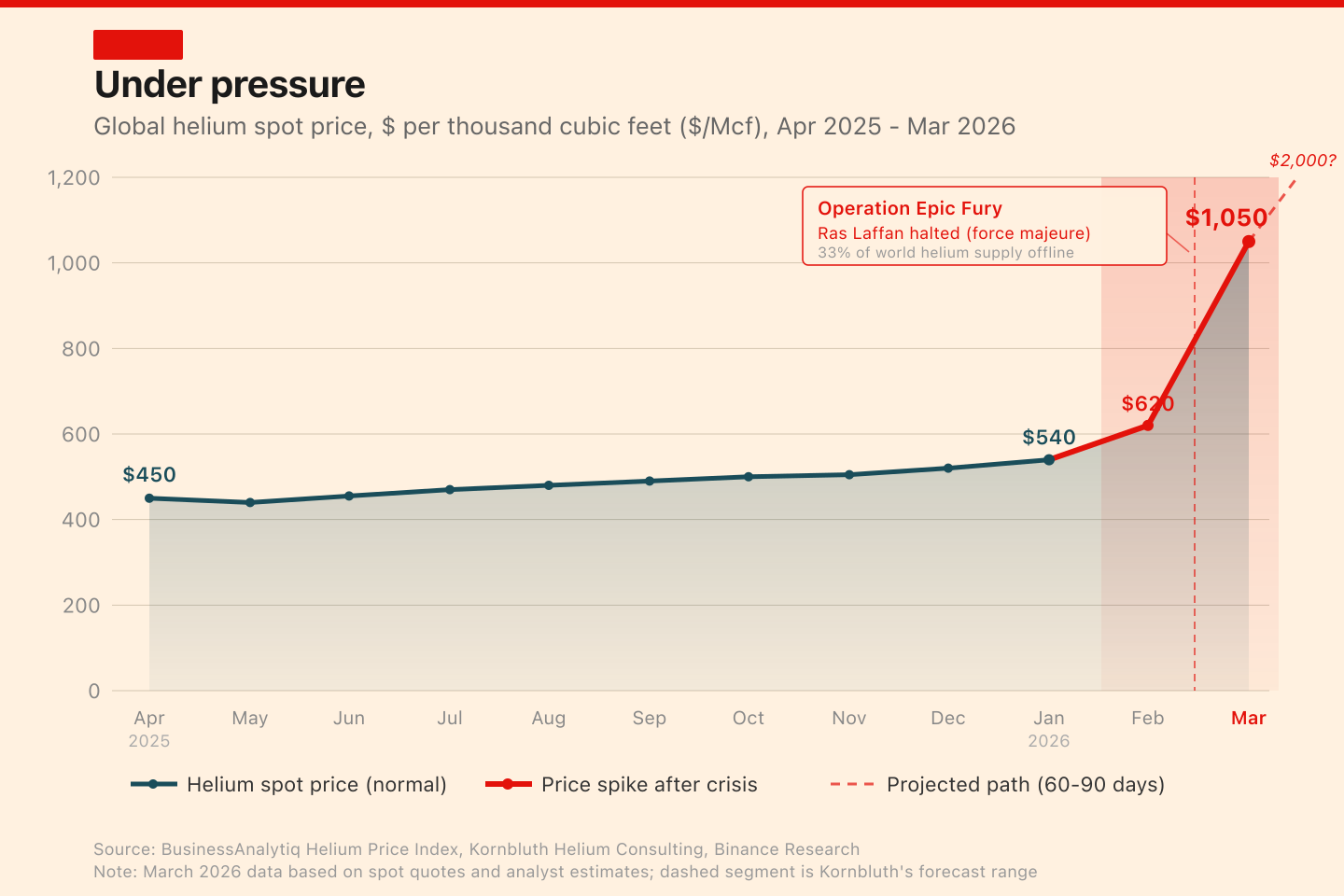
 Chart: global helium spot price (April 2025 to March 2026), in dollars per thousand cubic feet. After the Ras Laffan shutdown in March 2026 the price jumped from about $500 to $1,050, and industry analysts expect it to break $2,000 if the interruption runs 60 to 90 days. Sources: BusinessAnalytiq Helium Price Index, Kornbluth Helium Consulting.
Introduction: Physical Reality Collides With Virtual Expansion
As of March 2026, the global economy and the technology industry sit at an extremely fragile intersection. On the surface, the turbulence in international markets comes from the sharp escalation of geopolitical conflict in the Middle East and the conventional energy supply crisis it set off. Look closely at the underlying transmission mechanism, though, and it becomes clear that this regional conflict has passed through a hidden node in the physical supply chain and punched straight through both foundations of the 21st century digital economy and the artificial intelligence (AI) industry. The Middle East oil and liquefied natural gas (LNG) crisis has produced vicious inflation in conventional energy markets, and it has also cut off global supply of an industrial gas that is absolutely critical and that macroeconomists have ignored for years: helium.
That physical shortage is now spreading rapidly along the semiconductor supply chain, hitting the core of advanced foundries in Korea and Taiwan, and from there choking off production of high-capacity storage devices for data centers. Worse, the hard ceiling on physical semiconductor capacity and the rapid climb in energy costs are colliding with a rare capital expenditure (CapEx) frenzy in AI driven by the hyperscalers. High energy costs, the exhaustion of a critical cooling gas, and a heavily financialized structure built on off-balance-sheet leverage together form a perfect storm capable of puncturing an AI financial bubble worth trillions of dollars. This piece looks at second- and third-order effects to analyze the tangled causal network and systemic fragility linking the energy shock, the materials shortage, chip manufacturing and the AI capital market.
1. The Middle East Geopolitical Fault Line and the Repricing of Global Energy
The Middle East conflict that broke out in early 2026 has done more damage to global supply chains than any regional friction in the past decade, for one core reason: it directly reached and effectively blocked the "throat" of global energy transport, the Strait of Hormuz. That physical blockage produced an immediate and violent inflationary reaction on the pricing side of the macro economy.
1.1 Logistics Paralysis at Hormuz and the Crude Oil Shock
According to the latest ship tracking and maritime logistics data, after the crisis began as much as 16 million barrels a day of crude and refined products stopped moving through the Strait of Hormuz, a stunning 80% collapse against the 2025 average1. In a typical peacetime period, 70 to 80 large tankers and LNG carriers pass through the strait each day, but a four-day sampling window after the 2026 conflict began recorded only 10 vessels making the transit1. That cliff-edge interruption instantly triggered panic buying in global energy futures and spot markets.
Data models from the U.S. Energy Information Administration (EIA) and multilateral financial institutions show Brent crude spot prices breaking through the $95 per barrel psychological threshold in the first quarter of 2026, with the expectation that it will keep trading above $90 per barrel through the second quarter2. The EIA also revised its energy market indicator forecast, noting that U.S. regular retail gasoline is expected to rise from an average of $3.10 per gallon in 2025 to $3.34 per gallon in 2026, and that even with domestic crude production holding at a record 13.6 million barrels a day, the U.S. cannot hedge away the scarcity premium in international markets3.
| Energy category / key metric | Baseline (2025 average) | After the crisis (March 2026) | Decline / share of impact | Expected recovery and market view |
|---|---|---|---|---|
| Crude and refined product flows | ~20 million barrels / day | ~4 million barrels / day | Down 80%1 | Depends on how geopolitical intervention progresses |
| LNG exports | Normal operation | Down 1.5 Mt / week | 19% of global supply4 | Restarting the facilities takes weeks at minimum4 |
| Brent crude spot price | $69 / barrel3 | >$95 / barrel3 | Up more than 37%3 | May peak around $90 in Q22 |
| European TTF day-ahead gas | €30 / MWh4 | >€55 / MWh4 | Up 83.3%4 | Depends heavily on alternative supply |
Table 1: quantified impact of the March 2026 Hormuz closure on global energy supply (integrated analysis of structured sources1)
1.2 Marginal Pricing in European Power Markets and the Inflation Rebound
The direct victim of the energy crisis is the European market, which depends heavily on imported fossil fuels, and the spike in gas prices has ruthlessly exposed how sensitive European power systems are to the marginal pricing system. Under that mechanism, the most expensive generating technology needed to meet final demand (usually gas or coal) sets the clearing price for the whole system6.
On March 9, 2026, Dutch TTF day-ahead gas broke through €55/MWh, well above the roughly €30/MWh before the conflict4. Statistical regression shows just how rigid this price transmission is. In Germany the correlation coefficient between gas and power prices is very high, and in Italy, where gas sets the power price 89% of the time, that coefficient is close to 14. Quantitative models show that every €30/MWh increase in TTF gas typically drags German power prices up about €40/MWh4.
Europe has pushed hard on the energy transition for years, and renewables and low-carbon sources have gone from 51% of the European power mix in 2022 to 66% in 20254, adding 306 TWh of low-carbon supply between 2022 and 20254. Under an extreme external shock, though, the power system's fuel-switching capacity remains very limited. The macro data show that a 77% jump in gas prices (from €36/MWh to €64/MWh) only pushed gas-fired generation down by 5% through the price mechanism4. Even with Germany calling on 4.5 GW of hard coal capacity from its strategic reserve, adding roughly 20 TWh of coal generation, it is hard to stop gas prices from feeding through to power prices in the short term4.
This kind of rigid price increase forces central banks to reassess their macro models. Working from the market futures path as of March 11, 2026, the European Central Bank (ECB) staff baseline projection had to concede that the shipping disruptions and infrastructure attacks from the Middle East conflict have again cast a large shadow over the euro area outlook, with a significant near-term rebound in inflation expected, which sharply limits the room for monetary easing and holds down expectations for recovery2. The UK's Institute for Fiscal Studies (IFS) makes a similar comparison, noting that while the current gas price shock has not reached the extreme of real prices tripling at the outbreak of the Russia-Ukraine war in 2022, wholesale gas prices surged 67% in the two weeks between February 28 and March 12, which is already an unbearable cost pressure for government budgets and end consumers7.
2. The Hidden Lifeline: Systemic Paralysis of the Global Helium System
If rising oil and gas prices are the "visible wound" of the global macro economy, the collapse of the helium supply chain caused by the LNG cutoff is a "silent heart attack" deep inside the digital economy and advanced manufacturing. The crisis reveals how pathologically dependent the modern technology supply chain is on a handful of geographic nodes and specific physical elements.
2.1 The Ras Laffan Shutdown in Qatar and an Absolute Supply Vacuum
In modern industry, helium is not "manufactured" through a chemical reaction. It is separated out as a high-value by-product of natural gas extraction and liquefaction (LNG)8. In March 2026, after a large-scale drone attack (known as Operation Epic Fury), QatarEnergy was forced into an emergency shutdown of the world's largest LNG export facility at Ras Laffan and declared force majeure to its customers8.
What makes this so damaging is how concentrated global helium supply is. Qatar is the world's second-largest helium producer, with roughly 33% of the market (Qatari helium output reached about 63 million cubic meters in 2025)8. The sudden closure of Ras Laffan means roughly 5.2 million cubic meters a month of irreplaceable helium supply vanished from the global market overnight8.
Helium's physical and chemical properties also make its supply chain more fragile than that of any other commodity. The helium molecule is so small that it can pass through metal lattices, and it escapes into the atmosphere very easily. Liquid helium therefore suffers continuous boil-off losses during storage and transport8. The global helium supply chain cannot build large strategic reserves the way crude oil can, and typically runs with only about 45 days of buffer inventory8. That "produce and use immediately" model means that once upstream capacity goes offline, downstream industrial users burn through the inventory keeping their lines running in just two to three weeks13.
2.2 Extremely Inelastic Demand and Violent Price Inflation
Crude oil and natural gas demand can be suppressed at extreme prices by cutting general industrial activity or switching to alternative energy. Helium's core downstream applications, especially semiconductor manufacturing and medical MRI, have extremely inelastic demand9. In these high-precision fields helium is a critical material with no substitute. That irreplaceability meant the spot market fell into severe supply-demand imbalance and price panic as soon as the crisis hit.
| Point in the crisis | Physical supply chain and logistics | Spot price inflation | Impact on industrial end users |
|---|---|---|---|
| Days 1-3 | Qatari facility attacked and shut down, strait exports physically blocked | Force majeure declared, panic spreads quickly through the market | Spot purchase agreements frozen, new orders refused |
| Days 4-7 | Roughly 30%-33% of absolute global supply formally leaves the market | Spot prices jump 50%-100%13 | Industrial gas distributors begin allocating shipments pro rata |
| Weeks 2-3 | Liquid helium buffer stock in transit approaches its boil-off limit | Double the pre-conflict price8 | Tech manufacturers and research users exhaust on-site inventory |
| Weeks 4-8 (expected) | Backup capacity in the U.S., Algeria and elsewhere cannot close the absolute gap quickly | Prices expected to rise another 25%-50%, past $2,000 / Mcf8 | Foundries face forced production cuts and heavy yield-loss risk13 |
Table 2: transmission timeline and price response model for the 2026 helium supply shock (integrated sources and theoretical timeline mapping8)
Phil Kornbluth, chairman of the industry consultancy Kornbluth Helium Consulting, warns bluntly that it is hard to imagine the world avoiding at least two to three months of lost helium production and four to six months to restore the supply chain5. If the interruption lasts 60 to 90 days, prices could climb another 25% to 50% on top of an already doubled level, possibly breaking the $2,000 per thousand cubic feet (Mcf) mark, more than four times what the industry generally expected at the start of 20268. More seriously, the speed at which a geopolitical interruption turns into real destruction downstream is far faster in helium than in any other commodity, leaving companies almost no window to restructure their supply chains13.
3. Physical Bottlenecks in Semiconductor Foundries and the East Asia Crisis
The sudden tightening of helium supply cuts straight into the most fragile and most central physical link in the global digital economy and AI supply chain: the East Asian foundry system. In an industry worth hundreds of billions of dollars a year and holding up global information technology, helium almost never appears in a prominent place on a company's financial statements or in board-level strategy discussions, yet it is an absolutely irreplaceable physical barrier15.
3.1 An Irreplaceable Thermal Management Dependency at Advanced Nodes
In modern microelectronics manufacturing, particularly at 5nm and below (the nodes that dominate logic chips, high bandwidth memory (HBM) and AI accelerators), helium's extreme physical properties make it the lifeblood of the production line10. Helium has very high thermal conductivity, near-absolute chemical inertness and a very high diffusion coefficient. In manufacturing it is used mainly for rapid wafer cooling in extreme ultraviolet (EUV) lithography, plasma etching and chemical vapor deposition. In ultra-high-purity vacuum environments it is also the only effective medium for sub-micron leak detection10.
Semiconductor manufacturing is extremely temperature sensitive. If a helium shortage degrades thermal management, temperature control during wafer processing drifts slightly. At nanometer scale that drift is amplified without limit, causing lithographic pattern misalignment or uneven etch depth, so wafer defect rates climb sharply, good die counts collapse, and per-chip manufacturing cost rises substantially17. With compute demand exploding, this kind of yield volatility eats directly into foundry margins and creates severe delays in downstream AI accelerator supply.
3.2 Structural Fragility in Korea and Taiwan and Multiple Materials at Risk
In this supply chain storm, the two East Asian semiconductor powers that control the vast majority of advanced node capacity, Korea and Taiwan, have exposed serious structural fragility10. Korea holds 18% of global semiconductor production capacity and also controls roughly 70% of the global DRAM market and 80% of the HBM market (mostly through Samsung Electronics and SK hynix)5. Yet Korea's industrial gas supply is almost entirely imported. Korea International Trade Association (KITA) data for 2025 show that 64.7% of the country's helium imports come from Qatar11.
As the crisis spreads, the shortage extends well past helium. In March 2026 Korea's Ministry of Trade, Industry and Energy launched an emergency deep-dive review of its supply chain, focused on 14 critical semiconductor materials and pieces of equipment that depend heavily on Middle East sources11. Besides helium, that sensitive list includes bromine, a key chemical for circuit formation and etching, which has caused considerable alarm in the industry, since as much as 90% of Korea's bromine imports come from Israel and Jordan, both at the center of the current regional conflict11. Concentrating several indispensable core materials in a single, highly unstable, geopolitically risky region is a textbook single-point-of-failure crisis13.
Large manufacturers such as SK hynix have issued statements claiming they have diversified their helium supply to some extent and hold roughly six months of buffer inventory against a 30% cut in global capacity11. Frontier technical analysis points out, though, that even at the most advanced fabs, which have spent heavily on internal helium recovery systems (which under ideal conditions recover 90% to 95% of helium from specific processes), the enormous consumption base and the fact that helium used in leak detection is completely unrecoverable mean that long-term net loss remains a mathematical dead end that static inventory alone cannot solve22. If the supply blockade from the Middle East runs past a quarter, the East Asian chip supply chain will face the hard choice between broad shutdowns and prioritizing high-margin orders24.
3.3 The Chain Collapse in High-Capacity Storage (HDD)
The third-order effect of the helium crisis shows up most vividly in the less glamorous market for data center storage hardware. With large language models (LLMs) in training and multimodal data exploding, AI data center demand for cheap, high-volume storage media has hit an all-time peak. Every enterprise mechanical hard drive (HDD) on the market above 10TB uses helium sealing technology17. Helium is one-seventh the density of ordinary air, so sealing a drive with helium sharply reduces air resistance and turbulence as the platters spin, which allows more platters to be stacked inside for higher storage density while cutting power draw and operating temperature.
Under the March 2026 helium cutoff, HDD manufacturers including Seagate and Western Digital have all been severely capacity squeezed. Western Digital CEO Irving Tan told investors on a recent earnings call that because of raw material constraints and AI customers buying everything available, the company's high-capacity drive capacity for all of 2026 is fully booked, with 95% of production allocation locked into long-term contracts with enterprise customers and hyperscalers and only about 5% flowing into the broader consumer market17.
With raw materials so scarce, high-capacity HDD spot prices have jumped 20% to 50% in a few months17. That hardware shortage is forcing IT decision makers to rethink data center storage economics. If HDDs cannot be supplied in volume, the only alternative at scale is a full shift to solid state drives (SSDs)26. That shift runs into a harsher double bind. First, NAND flash, the core component of an SSD, is made in the same foundry system that helium and bromine shortages have already put at risk26. Second, on cost, a high-capacity enterprise SSD already costs 16 times as much as an HDD of the same capacity25. This spiral in storage hardware cost is planting a time bomb under the overall economics of AI infrastructure buildout.
4. Energy Consumption and the Cost Tipping Point in AI Infrastructure
The AI industry in 2026 has not slowed its frenzied capital expansion because of geopolitical turmoil or physical materials shortages. If anything the hyperscalers (Microsoft, Meta, Amazon, Alphabet) are deep in an arms-race-style capex supercycle. Yet upstream physical constraints, above all extreme energy consumption, are relentlessly tightening the economic boundaries of the whole track.
4.1 From Model Training to Inference at Massive Scale
By 2026 the computing paradigm and center of gravity of the AI industry have made a real jump: from training-dominated in the early years to irreversibly inference-dominated27. Comprehensive empirical analysis from MIT Technology Review finds that in today's AI operating environment, large model inference already consumes 80% to 90% of all AI compute28.
The direct systemic consequence of that shift is a sharp rise in underlying energy use. The per-query power draw of generative AI is striking and highly variable. A basic text generation query uses between 0.03 and 1.9 watt-hours (complex reasoning at the high end), high-resolution image generation needs 0.6 to 1.2 watt-hours, and long-context video generation (say a single 5-second high-fidelity clip) consumes close to a full kilowatt-hour. That is more than 800 times the energy of a single traditional Google search28. Rigorous carbon measurements by HM Hochschule München across 14 open-source LLMs spanning 7 billion to 72 billion parameters confirm the point: model parameter scale, inference accuracy and operating energy use (and the carbon emissions that follow) have a very steep positive relationship, and advanced symbolic and abstract reasoning is especially demanding of compute and power29.
At the grid level, a Morgan Stanley industry report notes that global data center power demand is climbing about 126 gigawatts (GW) a year, an increment nearly equal to Canada's entire annual electricity demand30. Forecasts from Lawrence Berkeley National Laboratory in the U.S. are blunter and more pessimistic: by 2028, AI inference alone will consume 165 to 326 terawatt-hours (TWh) a year, enough to supply 22% of American households for a full year28.
4.2 Energy Price Spikes and the End of the Moore's Law Deflation Dividend
Against that backdrop of extreme energy intensity, the macro energy price spike from the Middle East crisis has become the single most important external variable crushing AI compute economics. Empirical data show advanced AI data centers draw five times the power per unit of floor area of conventional cloud facilities10. When European power markets push prices past €55/MWh on gas scarcity, and when aging U.S. grid infrastructure and badly lagging expansion timelines make power availability rather than chip availability the largest absolute bottleneck on AI expansion, hyperscaler total cost of ownership (TCO) deteriorates catastrophically10.
At the same time, the shortages of helium, bromine and other critical precursor gases described above are directly raising semiconductor defect rates and wafer scrap. To keep supplying high-margin AI accelerators (Nvidia's high-end GPUs, for instance), monopoly foundries such as TSMC will inevitably pass, and have already begun passing, the extra environmental costs, material premiums and yield losses down to fabless chip designers and cloud providers. Deloitte's 2026 semiconductor outlook states plainly that rising front-end wafer fab equipment costs, combined with AI chips leaning ever more on complex chiplet interconnects and 3D stacking of high bandwidth memory (HBM), are together pushing the underlying components of AI compute into a very high price band32.
In the physical world, with baseload power no longer cheap and industrial refrigeration and process gases both scarce and expensive, the capital threshold for training and running frontier LLMs has taken a steep hockey-stick shape. The data show that the base cost of training a frontier model with hundreds of billions or even trillions of parameters has gone from a trivial few hundred dollars in the early Transformer era of 2017 to on the order of $100 million to $200 million in the GPT-4 and Gemini Ultra era of 2024-2025, and it keeps climbing in 2026 on inflation and compute scarcity35. The rapid deflation dividend in hardware compute costs that Moore's Law delivered over the past decade was finished off in 2026 by the exhaustion of the physical supply chain.
5. Fragility in the AI Financial Structure: Off-Balance-Sheet Leverage and Recursive Demand
When the physical foundations (baseload power, cooling water, rare industrial gases) start shaking hard, the enormous financial structure built on top of them faces its harshest macro stress test. The AI boom of 2026 is a deep technological revolution, and it is also a highly complex financial leverage experiment incubated in the residual warmth of the low-rate era.
5.1 A Capex Frenzy at Scale
S&P Global's latest 2026 ratings review discloses a jaw-dropping figure: combined capital expenditure guidance for the top five U.S. hyperscalers (Alphabet, Amazon, Meta, Microsoft and others) for fiscal 2026 has been raised aggressively by management to more than $700 billion, an annual increase of over 60%37. Morgan Stanley's macro strategy report puts that in historical context, noting that this wave of AI infrastructure capex will comfortably exceed the telecom equipment investment frenzy at the peak of the 2000 dot-com bubble in both absolute size and expected duration38.
Over the three-year forecast window from 2026 to 2028, these ecosystem-leading tech giants are expected to drive roughly 40% of total cash capital expenditure across the Russell 1000, with cumulative spending above $2 trillion38. To fund a gap that ordinary operating cash flow cannot cover, tech companies have been forced to borrow heavily in credit markets. Data from Reuters and related financial institutions show annual debt issuance directly tied to AI infrastructure and data centers rising from $166 billion in 2023 to $625 billion in 202539.
| Company | 2025 actual capex (estimated) | 2026 capex guidance | Where the money goes and how it is financed |
|---|---|---|---|
| Amazon (AWS) | $132 billion | ~$200 billion | Heavy bets on core cloud expansion and dedicated AI data centers37 |
| Meta | Data limited | Expected to jump 75%+ | Leans heavily on off-balance-sheet leverage, such as $30 billion for the Hyperion cluster37 |
| Alphabet (Google) | Data limited | Expected to double | Large spend on in-house TPU iterations and on locking up grid interconnection capacity37 |
| Overall trend (Top 5) | ~$437 billion | > $700 billion | A huge funding gap filled largely by private credit, SPVs and asset-backed securities (ABS)39 |
Table 3: projected AI capex and leverage characteristics for major U.S. cloud providers in 2026 (in billions of dollars, integrated source analysis31)
5.2 Duration Mismatch, ABS and the Danger in Off-Balance-Sheet Leverage
Spending on this scale has long since exceeded what the tech giants' balance sheets can safely carry. Modern structured finance engineering has been introduced into AI infrastructure across the board and aggressively: special purpose vehicles (SPVs), private credit, and asset-backed securities (ABS) written against data center revenue rights have become the core supports for this expansion39.
In Meta's $30 billion Hyperion supercenter project, for example, an intricate financial structure leaves only 20% of the construction cost on Meta's own balance sheet, with the remaining 80% of the debt neatly stripped out and hidden in separate financing vehicles40. What this really does is quietly shift the enormous technology depreciation and default risk onto infrastructure investment funds, insurance company asset pools and the balance sheets of private credit providers.
Buried in here is a duration mismatch, one of the deadliest traps in macro finance. Traditional lenders are used to valuing data centers with commercial real estate or telecom tower models, treating these compute facilities as long-lived infrastructure assets with 10 to 20 year lives and stable cash flows40. In AI, though, with Moore's Law and the underlying architecture evolving so fast, a fundamental generational turnover in GPU technology takes only 12 to 18 months40. Once the helium supply crisis described above blocks next-generation chip production, collapses yields and delays delivery, or once the Middle East crisis drives gas and power prices high enough that running an older, power-hungry GPU costs more than the compute it can rent out, ABS and SPV structures built on ten-year discounted cash flow models will instantly face the systemic risk of collateral residual value going to zero and mass debt default.
5.3 The Recursive Demand Trap and the Trigger for Implosion
Beyond the dangerous leverage structure, the other core systemic risk in today's AI financial system is its tightly closed set of recursive demand loops40. The driving force of the AI cycle is concentrated in a handful of tech giants that are simultaneously the largest buyers of chips, the suppliers of compute, the venture investors in AI startups, and the validators of each other's technology.
A typical recursive transaction works like this. A hyperscaler such as Microsoft or Amazon makes a strategic "investment" in a leading AI startup such as OpenAI or Anthropic in the form of billions of dollars in dedicated cloud compute credits. The startup has no choice but to spend those credits on compute from its own investor, which then shows up in the cloud provider's current financial statements as a spectacular surge in cloud revenue40.
Moving money from one pocket to the other creates the appearance of a boom on the income statement while artificially severing the link between compute demand signals and real, broad enterprise adoption. Because every player fears missing a technology generation, all of them are building near-identical large language models at any cost and competing for the same physical bottleneck resources (HBM memory, cooling helium, grid capacity), and this collective irrationality produces remarkable inefficiency and duplicated infrastructure across the industry40.
Put all of these dimensions together and the perfect trigger for an epic bubble collapse is already visible:
Hard input inflation: the geopolitically driven closure of the Strait of Hormuz has sent energy and critical rare gas (helium) prices soaring, which pushes up both chip prices from foundries such as TSMC and day-to-day data center electricity bills10.
Accelerated depreciation in compute economics: the surge in underlying material and energy costs prevents the cost of a single AI inference from falling at the expected Moore's Law rate, which makes commercialization at the application layer difficult.
Enterprise ROI falsified across the board: after the initial hype cycle, enterprise customers find they cannot earn a return on investment from expensive AI API calls and fine-tuning deployments sufficient to cover their costs41.
A break in the recursive chain: as soon as one tech giant slows or stops buying compute under capital market pressure, or a startup runs completely out of cash, the closed recursive loop reverses, and revenue across the whole ecosystem falls mechanically in a domino effect.
Leverage backlash and credit collapse: with utilization low, compute SPVs cannot refinance their debt in a high-rate environment. Data center operators are forced to cut lease prices, which eventually sets off large chain defaults in the private credit and ABS products hidden off balance sheet40.
As the research from the quantitative hedge fund Man Group points out sharply, AI technology is unquestionably valuable, but the bubbly, leveraged financial structure built around it may already be past the point of sustainability. At the end of this cycle, the real losers will be the blind capital that tried to use financial leverage to cash in early on a temporary supply-demand imbalance during the compute buildout phase40.
6. Industry Self-Rescue, Geopolitical Restructuring and a New Supply Cycle
A systemic crisis inevitably forces painful structural evolution on an industry. When just-in-time supply chain optimization, taken to its extreme by globalization, proves helpless against fragile geopolitics, the technology industry is pushed to look for redundancy, self-sufficiency and new technical paradigms.
6.1 The Strategic Premium on Independent Helium Projects: Tanzania and North America
Because Qatar's single point of failure exposed how unstable helium supply is when it rides on natural gas production, global capital has turned toward independent "primary helium" projects that do not depend on hydrocarbon extraction42. These resources, located far from Middle East conflict zones, now enjoy a considerable geopolitical risk premium.
The helium project in the Rukwa Basin of Tanzania in East Africa (led by Helium One Global) has made a breakthrough during the crisis. The latest 2026 test data show that after an extended pumping test, its Itumbula West-1 (ITW-1) well achieved a remarkable surface helium concentration of up to 9.2%, with flow rates six times higher than natural flow after installing an electric submersible pump (ESP)44. The same company's Galactica-Pegasus project in Colorado has also entered production, with its amine unit running and refined helium already going to the spot market47. Rapid commercialization of projects like these will be the most important strategic hedge available to Western technology over the next decade, easing a fatal dependence on Middle East supply43.
| Route out / region | Key players or technology | 2026 progress and technical milestones | Significance and limits |
|---|---|---|---|
| Independent helium basin development (East Africa) | Helium One Global (Tanzania) | ITW-1 well tested at a very high 9.2% helium concentration45 | Breaks the dependence on LNG by-product supply, but has to get past African infrastructure and logistics bottlenecks |
| Reviving domestic resources (North America) | Blue Star Helium / Helium One | Galactica amine unit online and selling into the spot market47 | Strengthens North American semiconductor supply chain resilience, though absolute output is still ramping |
| Foundry-level gas recovery | TSMC and Samsung with Linde/Air Liquide | 90%-95% recovery on specific process steps22 | Slows inventory depletion significantly, but cannot solve the 5% loss rate or the unavoidable consumption in leak testing22 |
| Helium-free medical equipment | GE HealthCare, Siemens Healthineers | 1.5T helium-free and low-helium MRI systems launched50 | Cuts liquid helium demand per scanner by 99%, freeing valuable market share for the semiconductor industry51 |
Table 4: emerging capacity and technical self-rescue in the global helium supply chain in 2026 (based on integrated market activity22)
6.2 Extreme Technical Evolution on the Demand Side: Low-Helium Designs and Full Recovery Economics
On the demand side, persistently high helium prices are forcing a technology revolution in medicine and semiconductors. In medical MRI, once a heavy helium consumer, Siemens Healthineers and GE HealthCare have accelerated the launch of helium-free and low-helium magnetic resonance systems. A traditional MRI system consumes close to ten thousand liters of liquid helium over its life, while new platforms such as DryCool use fully sealed designs to cut helium use by 99%50. That substitution takes enormous pressure off absolute helium demand and frees up strategic supply for the more critical semiconductor industry.
In semiconductor manufacturing, helium's physical properties in deep and extreme ultraviolet lithography thermal management are essentially impossible to replace chemically because of the laws of thermodynamics, so foundries are pushing on-site helium recovery systems forward at any cost. These systems are expensive, but with spot helium above a thousand dollars their payback period has shortened dramatically. Recovery systems at advanced fabs can now capture and purify 90% to 95% of the gas in closed loops22. As engineers in the field point out, though, even a 95% recovery rate leaves a residual 5% net loss that is a large absolute number against such a huge consumption base and such small vacuum leaks, so a fab can never close the loop and become fully self-sufficient22.
Conclusion: Toward a Deleveraged Digital Economy
Taking together macro geopolitics, microscopic physics and chemistry, and complex modern financial engineering, the Middle East oil crisis that broke out in 2026 is no simple regional energy shock. It is the fuse for a deep chain of fractures running through the contemporary global technology and real economy system.
First, the transmission runs all the way through the chain without mercy. By blocking shipping through the Strait of Hormuz, the shock pushed up global oil and gas prices and produced a second round of macro inflation, and more fatally it froze Qatar's critical helium exports. The loss of that unremarkable industrial gas by-product went like a knife into the thermal management soft spot of the East Asian semiconductor supply chain, and from there set off a full supply chain panic across 14 critical strategic materials including bromine, in particular paralyzing Korea's globally dominant memory chip (DRAM/HBM) production.
Second, physical constraints have ended the era of compute deflation for good. Threatened supply of critical gases and materials, combined with high-capacity mechanical hard drives running out, has wiped out the hardware cost decline that Moore's Law delivered over the past decade. At the same time, soaring electricity prices and a ceiling on data center efficiency gains have left energy-hungry AI inference workloads under suffocating operating cost pressure.
Finally, against that reality of sharply rising costs, the multi-trillion-dollar AI capex frenzy led by a handful of hyperscalers looks badly timed and dangerous. An AI financing structure that leans heavily on off-balance-sheet leverage (SPVs and ABS), carries a severe asset-life duration mismatch and depends on internal recursive revenue loops is already at the edge of collapse. If a physical supply cutoff delays equipment delivery, or energy costs stay inverted long enough that compute asset rents cannot cover debt interest, the result will quickly be chain defaults and revaluation across shadow banking and private credit markets, with very far-reaching damage to global financial markets.
Faced with this geo-techno-economic challenge, policymakers, semiconductor supply chain coordinators and macro institutional investors need to move quickly from blindly chasing a technology vision to pragmatically managing physical supply chains and geopolitical risk. In capital allocation, the market has to watch the excessive leverage risk in pure AI infrastructure builders and shift money and resources strategically toward AI application companies that genuinely cut costs and raise productivity, and toward hard-tech firms supplying decentralized critical raw materials (independent primary helium projects in North America or Africa, for example) and advanced thermal management and gas recovery technology. Only by loosening the energy and materials shackles of the physical world, and squeezing the false recursive bubble out of the financial system, will the next round of growth in the global digital economy be able to take a hit and last.
References
- Hormuz Disruptions and Asia's Energy Resilience, Gulf International Forum, accessed March 21, 2026.
- ECB Staff Macroeconomic Projections for the Euro Area, March 2026, European Central Bank, accessed March 21, 2026.
- EIA Releases Latest Short-Term Energy Outlook Amid Middle East Conflict, U.S. Energy Information Administration, accessed March 21, 2026.
- Middle East Conflict Drives European Power Price Volatility as Gas Disruption Removes 1.5 Mt LNG Weekly from Global Markets, Wood Mackenzie, accessed March 21, 2026.
- Middle East Turmoil and Materials Shortages Disrupt the Chip Industry, EE Times, accessed March 21, 2026.
- Middle East Tensions Push Gas Prices Higher, Exposing Europe's Energy Vulnerability, Strategic Energy, accessed March 21, 2026.
- What Does War in the Middle East Mean for Energy Prices, and How Could the Government Respond?, Institute for Fiscal Studies, accessed March 21, 2026.
- Helium Supply Disruption in the Iran Conflict Draws Global Attention, Binance Square, accessed March 21, 2026.
- Middle East Tensions Disrupt Global Helium Supply; Linde Well Positioned in a Tightening Market, International Gas Network, accessed March 21, 2026.
- US-Iran War Analysis: Will the Helium Crisis Hit Data Centres?, Data Centre Magazine, accessed March 21, 2026.
- Qatar Helium Shutdown Puts Chip Supply Chain on a Two-Week Clock, Tom's Hardware, accessed March 21, 2026.
- SEMI Says There Is No Chip Supply Shortage Yet, Taipei Times, accessed March 21, 2026.
- Helium Supply Shock: Key Market Risks and Industrial Impact, Discovery Alert, accessed March 21, 2026.
- Helium Price Index, BusinessAnalytiq, accessed March 21, 2026.
- Iran War Puts "Endangered" Helium Supplies at Risk as Qatar Halts Exports, The National, accessed March 21, 2026.
- How Sustainable Helium Can Help Futureproof the Semiconductor Industry, IDTechEx / OEM Off-Highway, accessed March 21, 2026.
- Helium Shortage 2026, Fusion Worldwide, accessed March 21, 2026.
- South Korea Flags Risk to Semiconductor Materials Amid Iran Conflict, Evertiq, accessed March 21, 2026.
- Middle East Conflict Poses Risks to Global Semiconductor Supply, South Korean Lawmaker Warns, GCC Business Watch, accessed March 21, 2026.
- Watch: Qatar's Helium, Israel's Bromine and Middle East Oil, Gate.io, accessed March 21, 2026.
- Chipmakers Watch the Middle East Closely as Supply Risk Mounts, Bitget News, accessed March 21, 2026.
- The Helium Shortage and the Semiconductor Supply Chain Crisis (2026), Kunal Ganglani, accessed March 21, 2026.
- Helium Recovery Systems Market Report, Forecast to 2035, Market Growth Reports, accessed March 21, 2026.
- Helium Shortage Threatens the Semiconductor Industry, bne IntelliNews, accessed March 21, 2026.
- AI Demand Clears Out Western Digital's Hard Drive Supply for 2026, PCMag, accessed March 21, 2026.
- The 2026 Storage Crisis: Why AI Data Centers Are Hoarding Every Hard Drive on the Market, How-To Geek, accessed March 21, 2026.
- Global Data Center Outlook 2026, JLL, accessed March 21, 2026.
- AI Inference Costs in 2025: The Energy Crisis and Sustainable Scaling Paths for a $255 Billion Market, Tensormesh, accessed March 21, 2026.
- The Energy Cost of Communicating with AI, Frontiers in Communication, accessed March 21, 2026.
- Energy Markets Race to Solve the AI Power Bottleneck, Morgan Stanley, accessed March 21, 2026.
- AI Infrastructure and the Energy Supercycle: 2026 Market Outlook, EBC Financial Group, accessed March 21, 2026.
- 2026 Global Semiconductor Industry Outlook, Deloitte, accessed March 21, 2026.
- Navigating the Semiconductor Manufacturing Costs, Boston Consulting Group, accessed March 21, 2026.
- Semiconductor Industry Outlook for 2026 Shows Rebound Amid Mergers, Sourceability, accessed March 21, 2026.
- The Real Cost of Training an LLM from Scratch in 2026, AI Superior, accessed March 21, 2026.
- Why the Next Phase of AI May Need More Compute, Not Less, Deloitte, accessed March 21, 2026.
- Sector Review: US Tech Earnings: Hyperscalers Again Are Hyperspending, S&P Global, accessed March 21, 2026.
- Morgan Stanley Sounds Alarm on New AI Spending Bubble Risk, TheStreet, accessed March 21, 2026.
- Valuing AI: Extreme Bubble, New Golden Era, or Both, GMO, accessed March 21, 2026.
- The AI Bubble: Hidden Risks and Opportunities, Man Group, accessed March 21, 2026.
- 2026 Outlook: Is AI a Bubble?, Cresset Capital, accessed March 21, 2026.
- Helium, Neon, Argon, Krypton and Xenon, U.S. Geological Survey, accessed March 21, 2026.
- Why Helium Supply Matters for Semiconductors: Extraction, Purification and the Risks in 2026, Valuates Reports, accessed March 21, 2026.
- AIM Rule 17 and Schedule 2(g) Update, Helium One Global / Investegate, accessed March 21, 2026.
- Tanzania: Helium One Global Announces Southern Rukwa Project Update, Energy-Pedia, accessed March 21, 2026.
- HLOGF - Helium One Global Latest Stock News and Market Updates, Stock Titan, accessed March 21, 2026.
- Galactica Project Update, London Stock Exchange / HE1, accessed March 21, 2026.
- Helium One Says Production on Track at US Helium Project, AJ Bell, accessed March 21, 2026.
- Is Helium Running Out?, WestAir Gases, accessed March 21, 2026.
- 1.5T Helium-Free MRI System Market Outlook 2026-2032, Intel Market Research, accessed March 21, 2026.
- Helium Market Size, Share, Trends and Growth Analysis 2031, Mordor Intelligence, accessed March 21, 2026.