
Introduction: The Structural Paradox of Booming Numbers and Weak Cultural Export
Under the twin waves of globalization and digitization, the global recorded music industry is going through a paradigm shift without precedent. According to the Global Music Report 2026 published by the International Federation of the Phonographic Industry (IFPI), the global recorded music industry grew a strong 6.4% in 2025, with total revenue reaching a record 31.7 billion dollars, the eleventh consecutive year of growth1. Behind that headline number, the Asian market stands out in particular, posting double-digit year-on-year growth of 10.9%2. Within Asia, China's recorded music market grew at a startling 20.1% annual rate, overtaking Germany to become the world's fourth largest music market and the fastest-growing country among the global top 201. Meanwhile Japan, the world's second largest music market, staged a strong recovery of its own at 8.9%3.
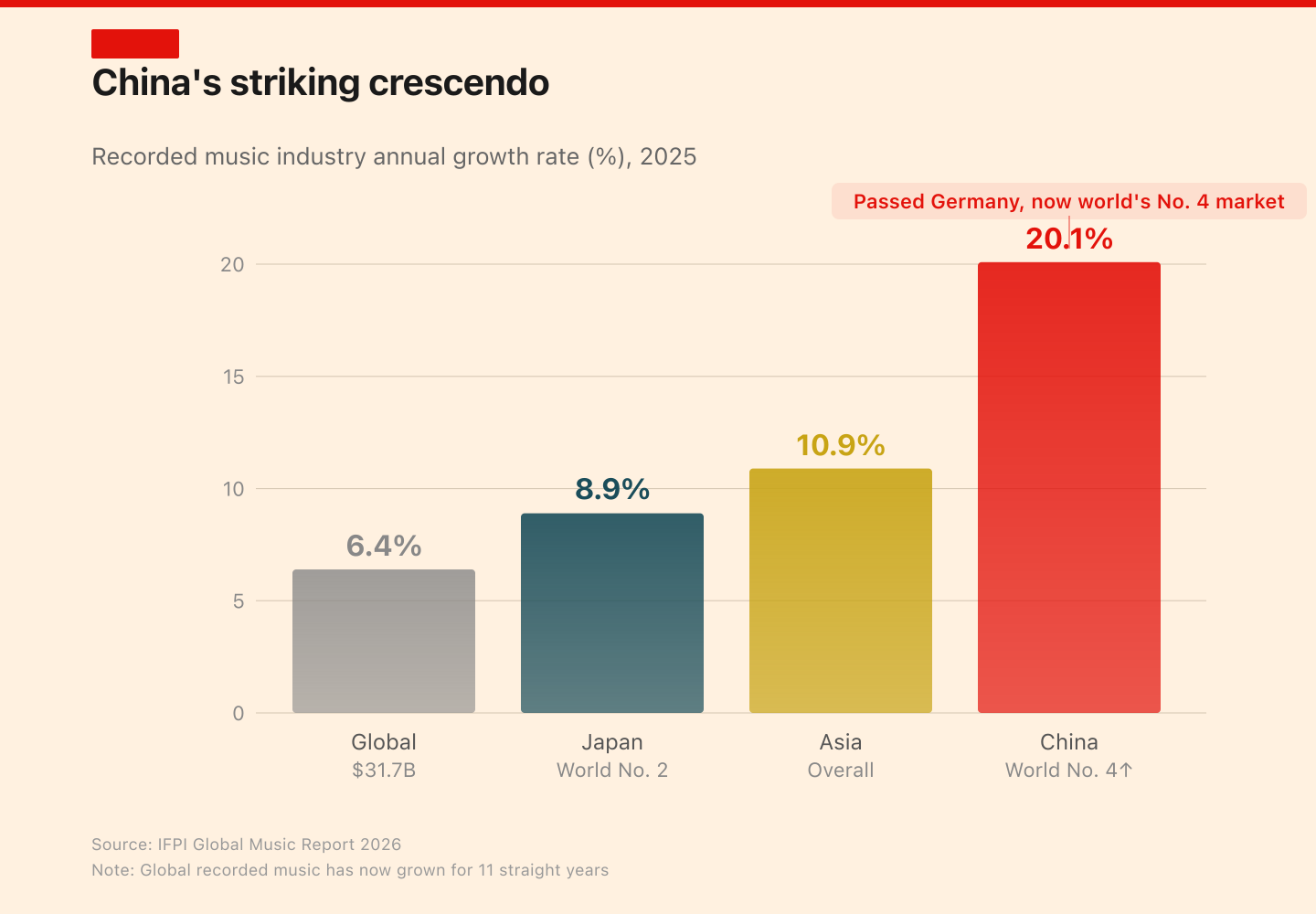 Figure: Annual growth rates in the global recorded music industry in 2025. China leads the world at 20.1%, overtaking Germany to become the fourth largest market. Source: IFPI Global Music Report 2026.
Yet behind the surging commercial numbers and rising valuations in the Chinese-language music industry, critics, longtime listeners and cultural researchers across Greater China share a pessimistic refrain: "Chinese-language music is in decline." That so-called decline clearly does not point to a shrinking industry or falling monetization. It points to the loss of creative control over content, the collapse of the album as a narrative form, a sinking standard of musical taste, and an extremely weak capacity to export across languages.
When we look at the most representative new-generation singers in each country, Fujii Kaze (藤井風) and Vaundy in Japan, Zhou Shen (周深) and Shan Yichun (单依纯) in China, the divergence between the two industries becomes clear: in their underlying logic, their star-making machinery, their fit with streaming algorithms, and their media ecology.
This piece draws on detailed cross-platform data (Spotify, YouTube, Billboard, Chartmetric and others), IFPI's macro industry reports, and a sociological reading of the recommendation algorithms underneath the short-video platforms (TikTok and Douyin) to examine why new-generation singers in the two countries rise along such different paths. The argument that follows is this: the "decline" of Chinese-language music is a structural tragedy in which music, as an independent art form, has been flattened into a "visual accessory" and background music (BGM) under the hegemony of a highly locally adapted short-video algorithm and a single distribution channel running through film, television and music variety shows.
1. The Industrial Base: Diverging Market Evolution and Revenue Structures
To understand why new-generation singers in the two countries differ so much in artistic expression and international reach, you have to start with the very different industrial bases and revenue structures underneath them. The physical medium of music and the channels through which it is monetized directly determine how creators survive and what they aim at.
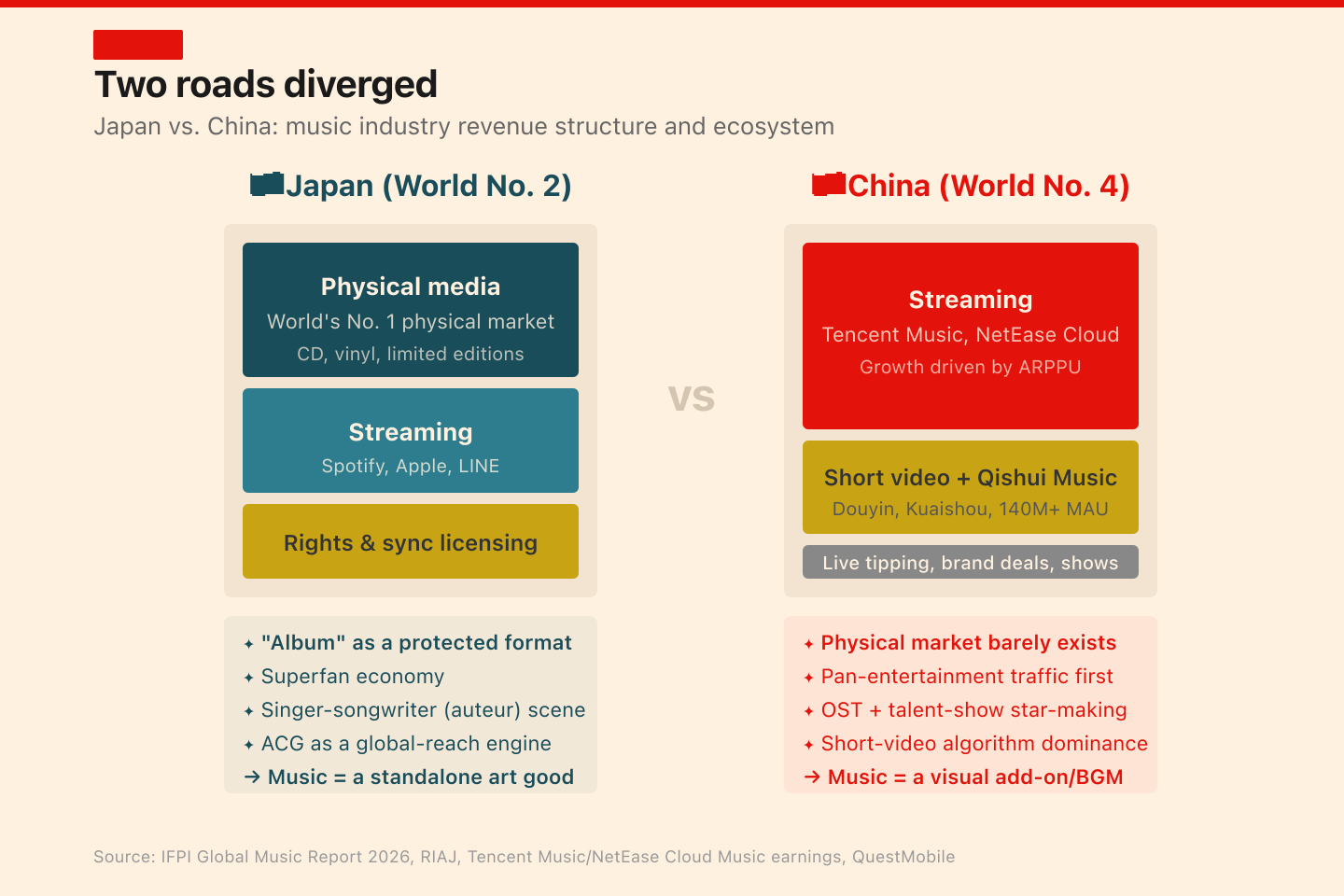 Figure: Revenue structure and ecosystem comparison between the Japanese and Chinese music industries. Japan retains a large physical record market, which gives the "complete album" an economic basis for survival; China is almost entirely digital, and music has become an accessory to a broader entertainment traffic arena. Sources: IFPI Global Music Report 2026, RIAJ, Tencent Music / NetEase Cloud Music earnings reports, QuestMobile.
| Global music market indicators (2025 data) | Japan | China |
|---|---|---|
| Global market rank | 2nd | 4th (overtaking Germany) |
| Annual growth (YoY) | +8.9% | +20.1% |
| Core growth engine | Physical record sales recovery, streaming subscriptions, globalized rights export | Pure streaming subscriptions (Tencent / NetEase Cloud), short-video traffic monetization, broad entertainment ecosystem |
| Position in physical music | World's largest physical market | Tiny physical share, almost entirely digital |
1.1 Japan: Holding On to Physical, and the Resilience of a Dual Track
Japan's music market has long been treated as an outlier in the global industry. With streaming sweeping the world, Japan has kept an enormous physical record habit. IFPI data shows that in 2025 Asia was still the largest physical music market globally, accounting for 45.1% of global physical revenue, and Japan, as the single largest physical market, drove global physical format revenue back up to roughly 5.3 billion dollars in 2025, an 8.0% year-on-year increase12.
Japan's attachment to physical formats (CDs, vinyl and so on) is not simply industrial lag. As the IFPI report notes, beyond serving as a listening format, physical products give "superfans" a tangible way to express affection and loyalty1. This dual-track structure, physical alongside digital, gives Japanese musicians a solid moat. It forces labels and artists to maintain the integrity and artistic quality of the album, a high-concept, long-form format, because consumers are paying a steep premium for a physical CD containing a dozen or more songs. That industrial inertia is the soil in which all-round new-generation creators like Fujii Kaze and Vaundy can work deeply on musical text and build large artistic universes.
1.2 China: A Purely Digital Streaming Oligopoly and an Entertainment Traffic Arena
China's music industry, by contrast, essentially skipped the mature physical record era altogether and plunged straight into digital streaming and short video, both dominated by internet giants. In this market, the subscriber counts and average revenue per paying user (ARPPU) of the online music giants, Tencent Music Entertainment Group and NetEase Cloud Music, are the key metrics of core growth4. At the same time, Qishui Music, riding ByteDance's vast traffic pool with a low-price or free strategy, rose fast: its monthly active users passed 120 million in September 2025 and climbed further to roughly 140 million by December of the same year, putting ByteDance firmly at the top table of the online music market5.
This heavily digital logic means monetization in China no longer depends on selling individual musical works (the revenue share of physical and digital album sales is shrinking). It depends on user time spent on the platform, on traffic distribution, on livestream tipping, and on crossover tie-ins with the rest of the entertainment ecosystem: dramas, films, games, variety shows. In that ecosystem music inevitably loses its standing as an independent consumer good and becomes a tool for attracting traffic and supporting visual content. The careers of Zhou Shen and Shan Yichun are products perfectly fitted to this entertainment traffic arena.
2. The Japanese Model: All-Round Singer-Songwriters and Coordinated Cultural Export
Among Japan's new generation, Fujii Kaze and Vaundy represent the currently dominant revival in J-Pop of the "producer-centric" system and the all-round singer-songwriter. They control not only lyrics and composition but also arrangement, production and even visual presentation, which makes their music extremely hard to substitute.
2.1 Fujii Kaze: From YouTube Covers to Global Streaming Star
Fujii Kaze's rise is a model case of traditional Japanese musical training meeting a globalized digital platform. Born in 1997, he studied classical piano from an early age under his father's influence and began uploading piano covers of pop songs to YouTube at twelve6. That deep musical grounding laid the foundation for his later all-round creative work. After being discovered by Universal Sigma, a label under Universal Music, he released his debut single "Nan-Nan" (何なんw) in 2019 and his first studio album Help Ever Hurt Never in May 20206. The album carried his philosophy of universal love during the pandemic and went straight to number one on Billboard Japan's Hot Albums chart. His second album Love All Serve All (2022) and his first all-English album Prema (released September 2025) continued the run, both debuting at number one on the Billboard Japan album chart.
His breakthrough numbers in international markets are striking:
Global ignition point: in July 2022, "Shinunoga E-Wa" (死ぬのがいいわ), a track from his first album, was used by Thai users on TikTok in fan edits of the anime Jujutsu Kaisen, which set off worldwide viral spread7. The song swept to the top of Spotify's Viral charts in 23 countries including Thailand, Indonesia, Vietnam, South Korea, the UK, France and the United States, and reached number 118 on the US Billboard Global 2007.
Streaming data: as of the first quarter of 2026, Fujii Kaze had 7.2 million monthly listeners on Spotify8. "Shinunoga E-Wa" is approaching 800 million streams on Spotify, "Kirari" (きらり) has passed 319 million, and "Matsuri" is over 205 million9. On YouTube he has roughly 4.8 million subscribers and more than 2.2 billion total views10.
Creative control: according to Songstats collaboration data, Fujii Kaze's control over his core tracks is very high. On "Shinunoga E-Wa" his contribution share reaches 78%, and on "Michiteyuku" (満ちてゆく), "Garden" (ガーデン) and "Hana" (花) it holds around 68%. His close work with top Japanese producer Yaffle ensures that his aesthetic, blending J-Pop, R&B, neo-soul and chill elements, comes through intact.
2.2 Vaundy: The Crossover Producer and Anime Culture Amplified
If Fujii Kaze represents the independent singer-songwriter full of humanistic reflection, then Vaundy, born in 2000, represents the most extreme version of the crossover producer model among Japan's new generation. Vaundy is not only a singer; he is also a working design student (Nihon University College of Art) who writes his own lyrics, composes, arranges, and takes on the art direction of his albums and the direction of his music videos as well11. Since blowing up online with "Tokyo Flash" in late 2019, he has swept through the Japanese scene with a startling release rate and an ability to work across genres.
| Vaundy's core streaming data and achievements | Figures and industry significance |
|---|---|
| Spotify monthly listeners | 5.9 million |
| Total Spotify streams | 2.87 billion |
| Songs past 100 million streams | 17 singles past 100 million streams, a record for a Japanese solo artist12 |
| "Kaijuu no Hanauta" chart dominance | The single passed 1 billion cumulative plays on Billboard Japan, the fourth song in Japanese history and the second by a solo artist to do so, and the youngest artist to reach it13 |
| High-volume single catalog | "Odoriko" (踊り子) 279 million streams, "Fukakoryoku" (不可幸力) 198 million, "Hanauranai" (花占い) 134 million12 |
| YouTube | About 2.4 million subscribers, roughly 2.4 billion total views14 |
Vaundy's success reveals the core advantage in Japan's route to internationalization: a powerful capacity to export in coordination with crossover culture, specifically anime, comics and games. His career is deeply tied to top global anime IP. He sang "Hadaka No Yusha" (裸の勇者), the opening theme for the phenomenon anime Ranking of Kings, wrote "Chainsaw Blood" as the ending theme for Chainsaw Man, and later contributed "Todome no Ichigeki" (feat. Cory Wong) to Spy × Family, plus "Homunculus" and "Gift" for the My Hero Academia films.
His role as a producer amplifies his industry influence further. He gives his own albums (Strobo, Replica) tightly unified conceptual packaging, and he frequently provides full lyrics-composition-arrangement production for other top artists. He wrote and produced "Backlight" for One Piece Film: Red for the breakout singer Ado; he tailored the chart-topping collaboration "Omokage" for the three vocalists Milet, Aimer and Lilas Ikuta (the singer of YOASOBI); and he wrote "Madou Ito" for the well-known actor Masaki Suda. This full-package production capacity makes Vaundy less a "singer" than an efficient and consistently high-quality hit factory inside the Japanese pop industry.
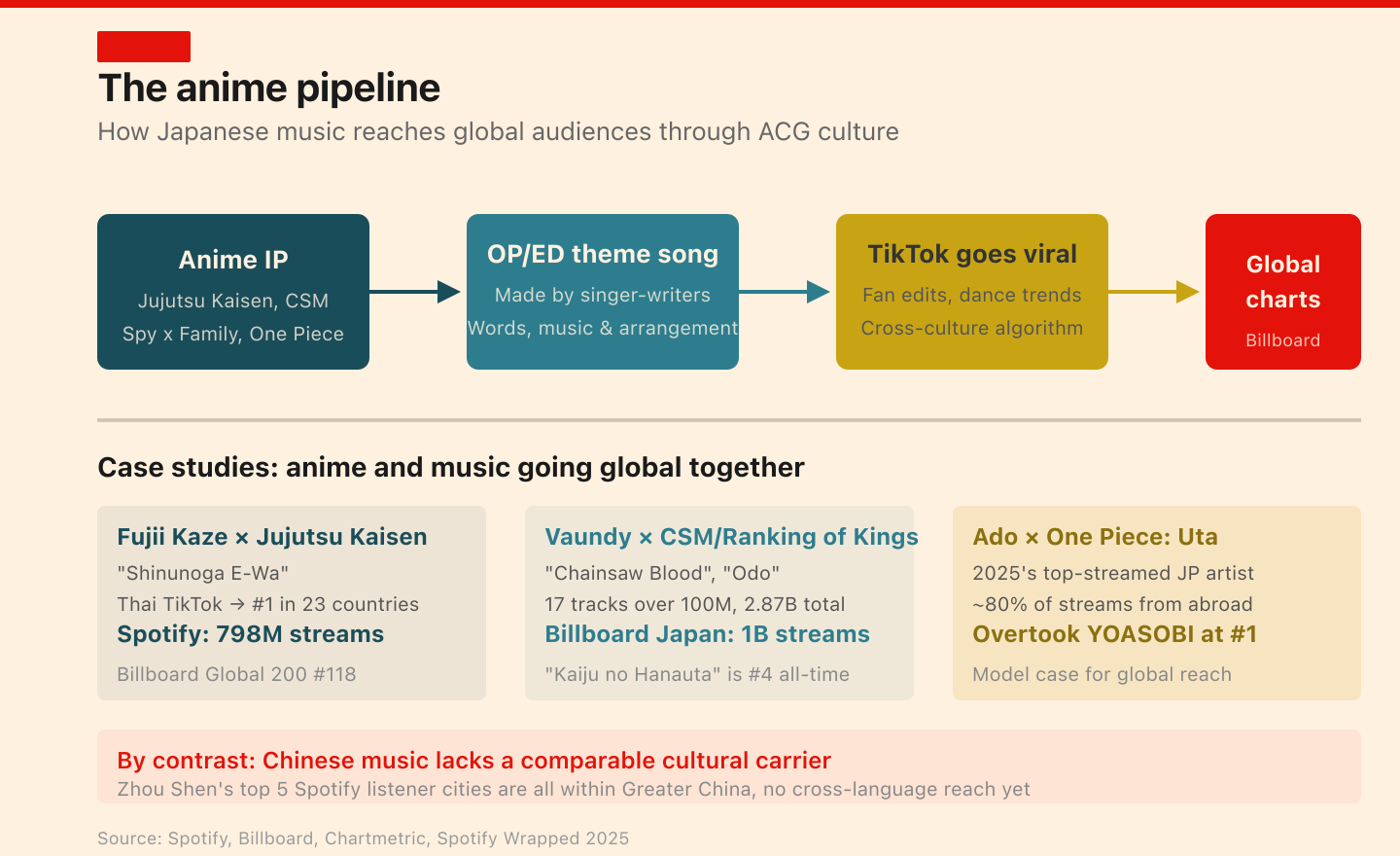 Figure: Japan's coordinated export path: anime IP → OP/ED theme songs → global spread on TikTok → global charts. Fujii Kaze, Vaundy, Ado and other new-generation singers all benefit from this cultural pipeline. Sources: Spotify, Billboard, Chartmetric, Spotify Wrapped 2025.
3. The Chinese Model: Extreme Vocal Performance and the "OST + Music Variety" Survival Rule
Turning back to the Chinese-language scene, Zhou Shen and Shan Yichun are without question the most nationally recognized and vocally accomplished figures of the new generation. But unlike their Japanese counterparts, their rise was not built on independent songwriting and album narrative. It depends heavily on two things specific to China: the custom-made OST (original soundtrack) and the television music variety show. They are performers at the highest level, the peak of a Chinese-language scene organized around vocal performance rather than authorship.
3.1 Zhou Shen: A "Heavenly Voice" Bound Tightly to the Screen Industry
Zhou Shen's voice is ethereal, clear, and androgynous in a way that is hard to place, which has made him the most sought-after OST singer for Chinese dramas, films and animation. On the major Chinese streaming platforms (Tencent Music, NetEase Cloud Music) his numbers are unambiguously top tier. But shift the frame to the global platform Spotify and look at the structure of his catalog, and the deeper bind facing Chinese-language music comes into full view.
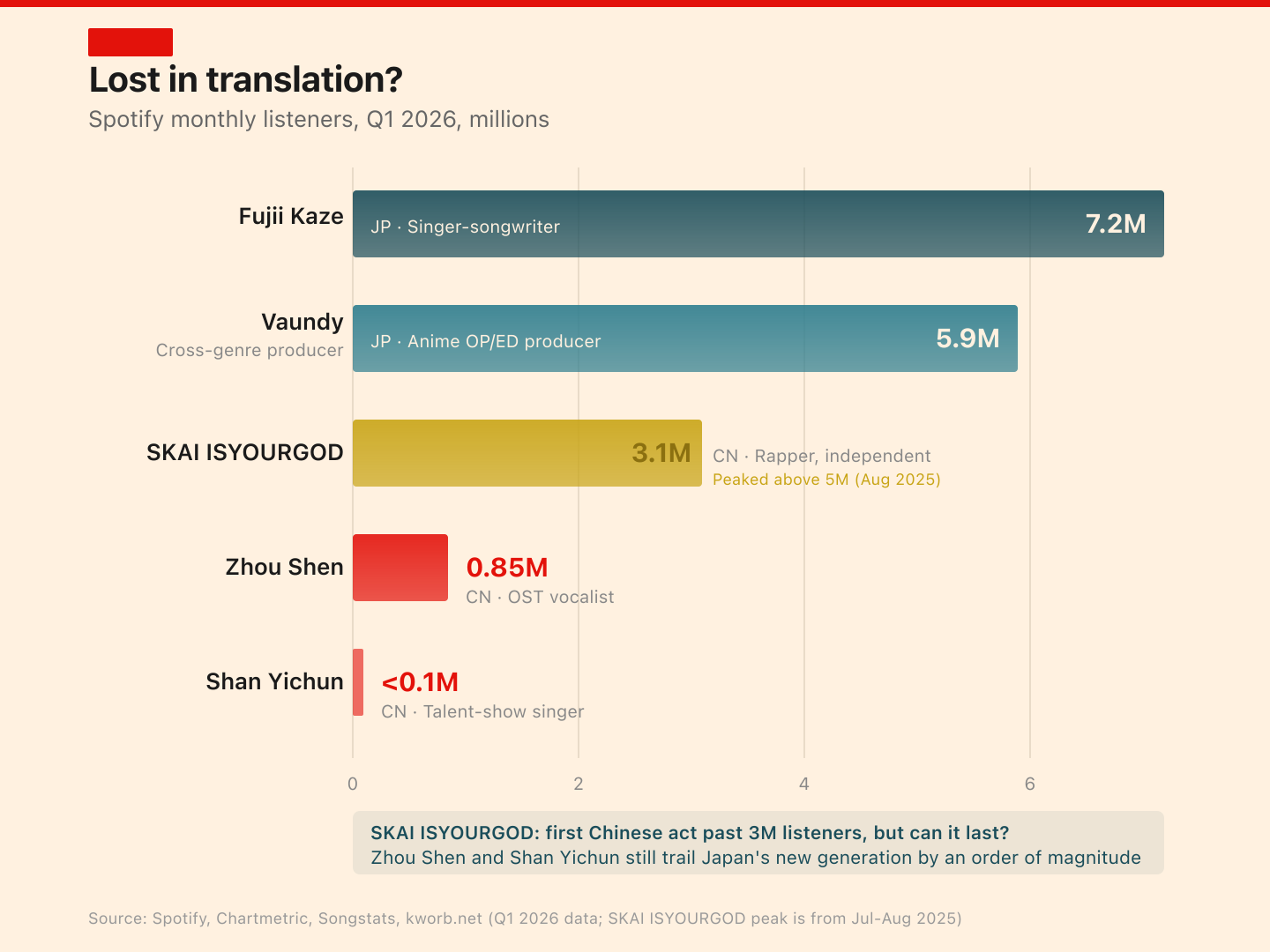 Figure: Spotify monthly listeners for new-generation singers in China and Japan. Fujii Kaze (7.2 million) and Vaundy (5.9 million) are about 8.5x and 7x Zhou Shen's 850,000. Sources: Spotify, Chartmetric, Songstats (Q1 2026 data).
According to Chartmetric and similar platforms, Zhou Shen has roughly 848,000 monthly listeners on Spotify15, an order-of-magnitude gap against Fujii Kaze's 7.2 million and Vaundy's 5.9 million. More telling still is where those listeners are:
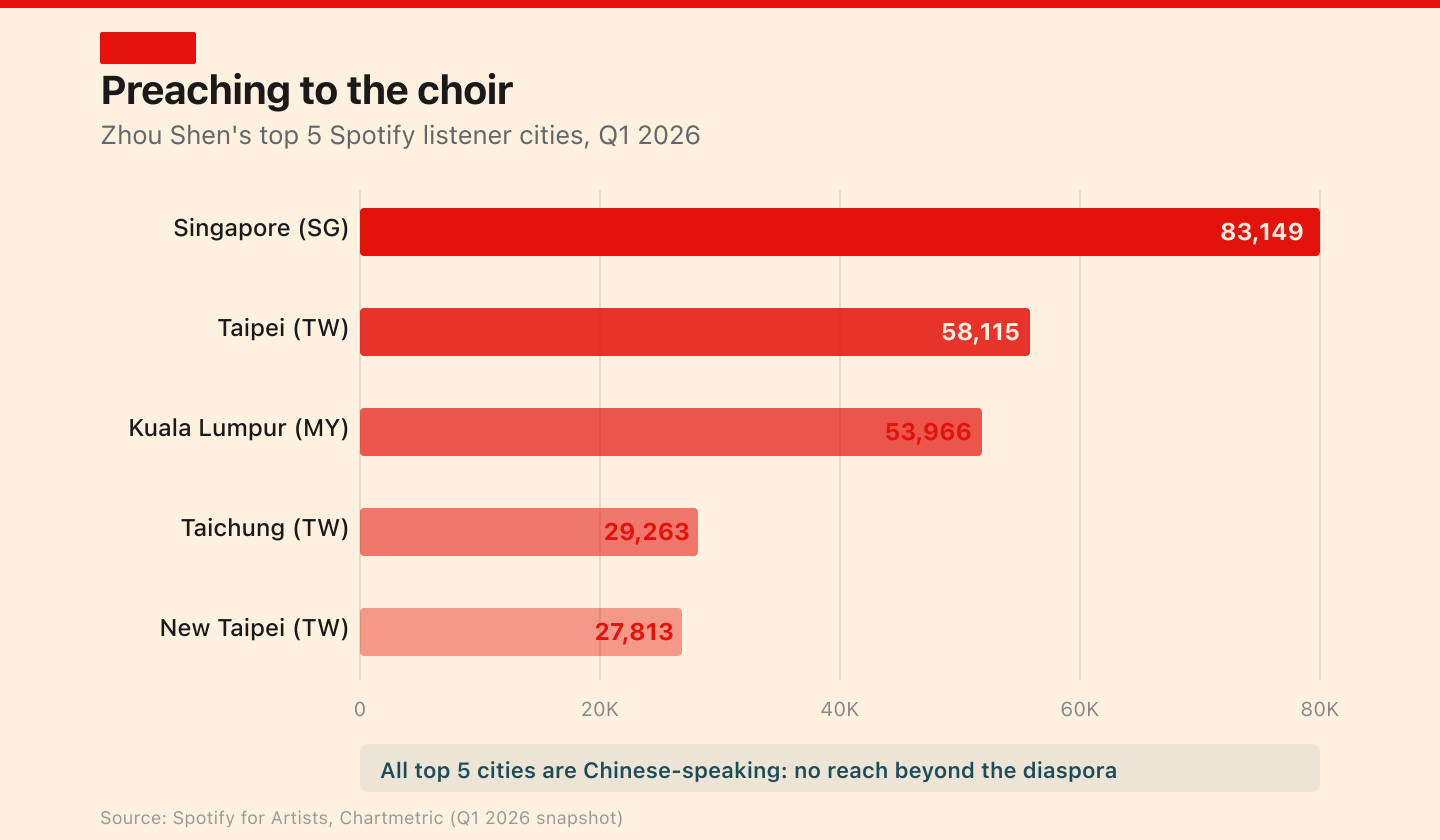 Figure: Zhou Shen's top five Spotify listener cities. All five sit inside the Greater China cultural sphere (the Chinese communities of Singapore and Malaysia, and Taiwan), with no penetration into audiences outside the language. Sources: Spotify for Artists, Chartmetric (Q1 2026 snapshot).
Zhou Shen's top five Spotify listener cities are Singapore (83,149), Taipei (58,115), Kuala Lumpur (53,966), Taichung (29,263) and New Taipei (27,813)15. That geography reveals something merciless: even for the very top of the Chinese-language scene, "international influence" remains almost entirely confined to overseas Chinese communities, Chinese emigrants, and the Greater China cultural sphere. Chinese singers have not achieved what Japanese singers have, penetration into non-native audiences across language and cultural barriers.
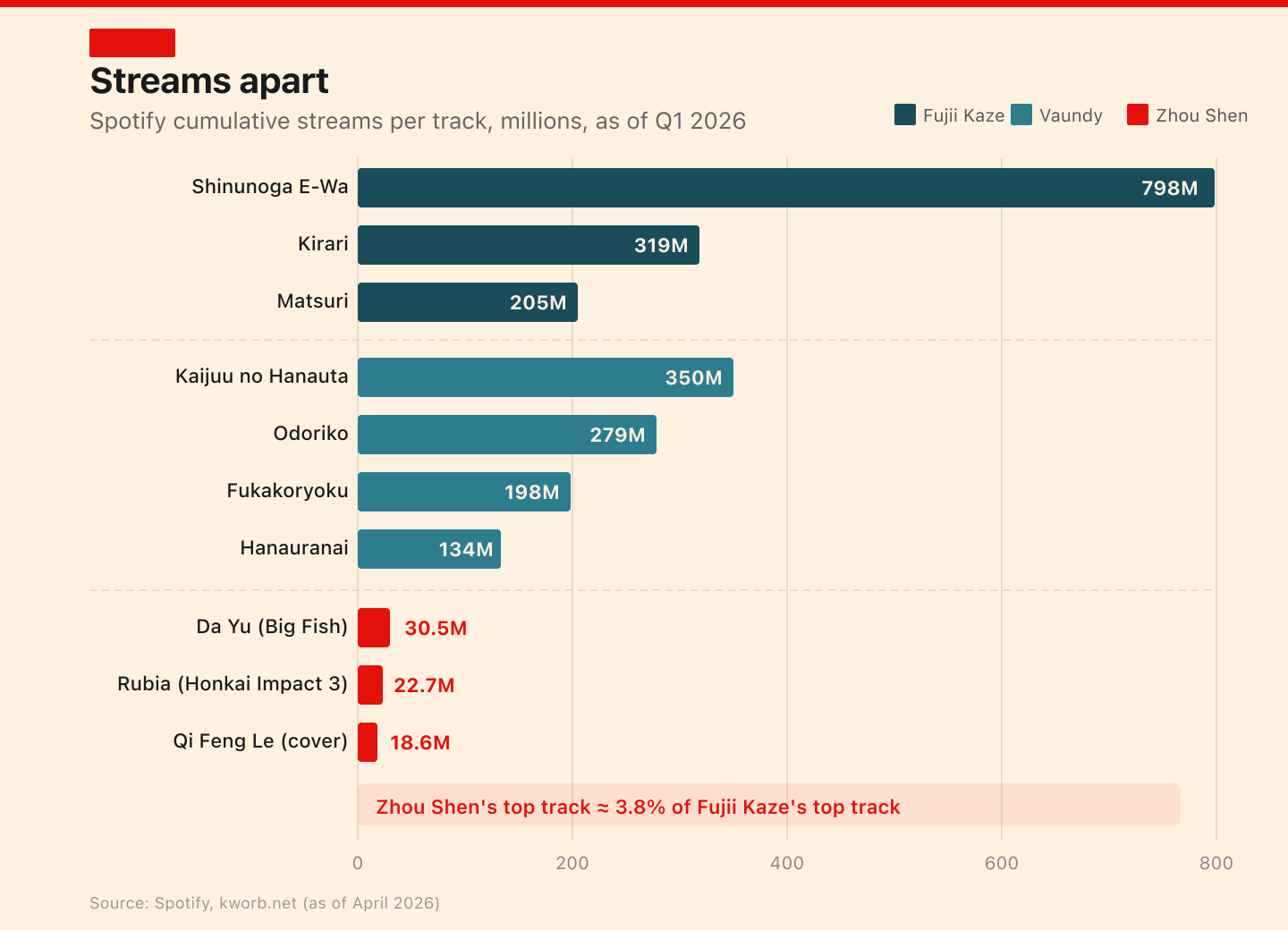 Figure: Cumulative Spotify streams for top singles by new-generation Chinese and Japanese singers. Zhou Shen's biggest track, "Big Fish" (30.5 million), is only 3.8% of Fujii Kaze's "Shinunoga E-Wa" (798 million). Sources: Spotify, kworb.net (as of April 2026).
Look at the structure of his catalog and Zhou Shen's most-streamed tracks on Spotify are almost uniformly screen OSTs or covers. For example:
- "Big Fish" (大鱼), image song for the animated film Big Fish & Begonia: 30.5 million streams16
- "Rubia", image song for the game Honkai Impact 3rd: 22.7 million streams16
- "The Wind Rises" (起风了), a cover of the same-titled song by Japan's Yu Takahashi: 18.6 million streams16
- "Yao Yiqi" (要一起), theme song for the drama The Sword and the Brocade: 8.6 million streams
- "Cocoon" (茧), ending theme for the drama The Long Ballad: 8 million streams
- "Yu Qing" (余情), theme song for the drama Love Between Fairy and Devil: 6.7 million streams
Zhou Shen has an enormous resume running to several hundred singles, but he himself rarely takes part in writing lyrics or music, or in the underlying arrangement and production. China's entertainment industry has shaped him into a precise, ornate, commercially valuable vocal instrument. Whether it is "Endless Sailing," the theme for the Three-Body series, or "Xiao Meiman," the companion song for the film YOLO, his job is to supply an emotional peak for a screen narrative that has already been set, not to build a personal worldview or philosophical statement through music. This split between writing and performing, this weighting of performance over authorship, means his work struggles to stand on its own in international markets once separated from the specific images on screen or from the Chinese-language context.
3.2 Shan Yichun: Cover Dependence and the Original-Material Bind Under the Variety Star Machine
Shan Yichun won the 2020 season of Sing! China (also the youngest winner in the show's history, at eighteen) and rose quickly on a voice full of conversational intimacy and soul texture17. Her career path is a perfect reproduction of the contemporary Chinese "music variety star-making" model.
Her fame, and the maintenance of it, depends heavily on cover performances in the big national music variety shows. Her Sing! China cover of Eric Chou's "Yong Bu Shi Lian De Ai" (永不失联的爱, a love that never loses touch) became a phenomenon; on Infinity and Beyond her Cantonese covers of Faye Wong's "The Edge of Love and Pain" and Twins' "Next Stop, Diva" drew wide discussion; and on the latest season, Singer 2025, she won the first episode with her own single "Zhu Yu" (珠玉)18. At the same time, she drew a broad copyright controversy by covering Ronghao Li's "Li Bai" at her own concert without authorization, after Li's side had already explicitly refused her cover request; she later apologized publicly18.
On the original-material side, although her label Baimu Entertainment has released two studio albums for her, Courage Quota (勇敢额度, 2022) and Chun Meimei (纯妹妹, 2025), the reach and streaming numbers of those originals fall far short of the OST singles she has recorded for films and dramas: "Firefly" for the film Fireflies in the Sun, "Your Treasure" for the film Bath Buddies, the title theme for the drama Love Like the Galaxy, and others.
Shan Yichun's bind is the whole new-generation Chinese vocalist cohort in miniature: top-tier vocal instrument, very high public recognition, and a passive position in the industrial chain. Without good original songwriting behind them, they can only keep reheating old material in variety shows, covering the classics, or serve as background music for drama marketing campaigns. That long grind squeezes out the space they would need to explore a personal style and release a complete conceptual album.
3.3 SKAI ISYOURGOD (Lan Lao): A Counterexample to the Douyin Hit, or the Beginnings of a Chinese Auteur?
Outside the "OST + variety" model of Zhou Shen and Shan Yichun, the singer who came out of nowhere in the summer of 2025, SKAI ISYOURGOD (揽佬, real name Chen Xukai, born 1998 in Huizhou, Guangdong), offers a counterexample worth examining. A former on-set extra and power company employee, he took a path entirely unlike Zhou Shen's or Shan Yichun's on the strength of two fully self-written studio albums, Shun Feng Shun Shui Shun Cai Shen (顺风顺水顺财神, 2023) and Ba Fang Lai Cai (八方来财, wealth from all directions, 2024)19.
His music grafts the drum patterns of American Memphis rap onto Guangdong folk culture, telling the social calculus of migrant workers with a wry humor, in lyrics that mix Huizhou accent, Cantonese, Teochew and Hakka. He writes both words and music, and has built a self-consistent aesthetic system with an extremely strong personal signature. That is exactly the auteur quality Zhou Shen and Shan Yichun lack.
In July 2025, after "Blueprint Supreme" (大展鸿图) and "Ba Fang Lai Cai" went viral on Douyin, something rare happened: a reverse spillover from Douyin to TikTok. Singaporean dancers choreographed street dance versions, Brazilian musicians made a Portuguese-language cover, and English-language TikTok creators produced lyric translations and cultural explainers20. His Spotify monthly listeners broke through 3 million, 4 million and 5 million within a single month, briefly passing Jay Chou to top the Chinese-language artist chart21. As of the first quarter of 2026, his monthly listeners have settled at around 3.1 million, and Ba Fang Lai Cai has passed 38 million total streams on Spotify21.
These numbers create an interesting tension with the argument here. He proves that Chinese-language music is not inherently unable to cross the language barrier. When a creator has a distinct enough personal style and cultural grounding, listeners worldwide will still get hooked on the rhythm and atmosphere even when they cannot understand a word. The mechanism is the same one that set off Fujii Kaze's "Shinunoga E-Wa" on Thai TikTok.
But his case also confirms the central worry of this piece. His globalization path, from a 15-second Douyin clip going off, to dance and imitation challenges on TikTok, to a flood of Spotify traffic, still runs on the logic of the anonymous hit. Of the overseas users consuming "Blueprint Supreme" on TikTok, how many will listen to both his albums end to end? Whether an explosion driven by short-video algorithms can convert into lasting artistic influence and a loyal global fan base remains an open question. Fujii Kaze's and Vaundy's global listeners, by contrast, accumulated through full album listening and emotional connection to anime narratives. The stickiness of the two is not remotely comparable.
His emergence suggests that the way out for Chinese-language music may lie less in cultivating more "divine voices" than in releasing more individuals with independent creative ability and a distinct cultural signature. But it also raises a deeper question: when even this breakthrough still depends on the 15-second viral logic of short video, has Chinese-language music really escaped the algorithm's cage?
4. Algorithmic Discipline and Diverging Media Ecologies: Douyin vs. TikTok
If a creator's personal choices are only the surface, then the deep structural force producing such a large divergence between the two industries comes from the recommendation algorithms underneath the short-video platforms. TikTok and Douyin both belong to ByteDance, but they differ fundamentally in algorithmic orientation, cultural export logic and monetization model, and that difference has rewritten the historical trajectory of music in both countries.
4.1 The Algorithmic Fork: TikTok's Global Spillover and Douyin's Local Adaptation
A study of cultural differences in short-video platform user engagement, based on a survey of 1,000 users and 50 representative content samples, reached an instructive conclusion: TikTok and Douyin display distinctly different cultural dynamics in content creation and diffusion22.
The study found that TikTok's algorithm-driven recommendation mechanism substantially promotes global content diversity, encouraging cross-cultural innovation and user interaction. Roughly 75% of TikTok users showed higher creativity in globally oriented content22. TikTok's For You Page algorithm builds quiet, efficient connections between different cultural circles. Under that globalized algorithmic logic, music, especially music with a distinctive rhythm, atmosphere or hook, becomes the best vehicle for crossing the language barrier.
Japan's music industry read this mechanism sharply. As described above, Fujii Kaze's "Shinunoga E-Wa" was ignited by Thai users' anime fan edits and then spilled through TikTok's global algorithmic network into South America, Europe and North America7. Spotify Wrapped 2025 confirms the pattern further: Ado displaced YOASOBI as the most-streamed Japanese artist globally, with nearly 80% of her streams coming from outside Japan; Creepy Nuts' "Otonoke" and the earlier "Bling-Bang-Bang-Born" became the most-streamed Japanese songs overseas; and the appearance of Joe Hisaishi and the ATLUS sound team on the charts again shows how strongly anime and game soundtracks drive global discovery of Japanese music23.
Japanese music, both J-Pop and anime and game scoring, fits TikTok's globalized algorithm perfectly, and has achieved efficient coordinated cultural export as a result.
The same study points out the opposite for Douyin in China, which heavily prioritizes local cultural adaptation. User engagement is strongly shaped by local algorithms and regional identity22. Inside Douyin's ecosystem, content closely fitted to a specific regional culture (lower-tier market sentiment, internet memes, local social moods) achieves click-through rates about 30% higher than ordinary content22. This locally adaptive algorithm has reshaped the Chinese music market into an enormous, internally circulating filter bubble.
For Chinese labels and creators, catering to the taste of hundreds of millions of domestic users and manufacturing a song that goes off on Douyin brings staggering direct commercial returns, through platform ad revenue sharing, livestream tips, brand endorsements and commercial performance circuits. Those short-term rewards have thoroughly killed any internal motivation for Chinese-language musicians to pursue international reach or raise their artistic bar.
4.2 Anonymous Hits and the BGM-ification of Music
Douyin's deepest damage to Chinese-language music is that it demoted music from an independent artwork requiring immersive listening to a visual attachment and background track for short video.
Academic work has looked closely at this. The paper "Charting Anonymous Hits: How Short Video Platforms Have Changed the Chinese Music Industries" points out that short video platforms (SVPs) are seriously eating into the market share of Chinese music streaming platforms (MSPs) and swallowing large parts of the marketing and promotion budgets of labels and artists24. In that ecosystem, a song's success no longer depends on how the whole piece develops or on its depth of thought. It depends on whether there is a 15-second chorus hook that works with a dance move, a comedic imitation or an emotional caption24.
That mechanism has produced an enormous volume of anonymous hits, for instance "Learning to Meow" (学猫叫), which once swept the entire Chinese internet24. The public consumed those 15 seconds of melody obsessively in short videos, but the overwhelming majority neither knew nor cared who was singing, let alone accumulated as fans or supported the building of a personal musical brand.
When music creation becomes an assembly line of A/B tests run against data feedback and algorithmic preference, simple melodies, blunt emotion-pandering lyrics and rough mixes optimized for phone speakers become the industry standard. Under that logic the album as a form takes a devastating hit. A ten-track studio album that took a year or two and explores complex human questions looks long, inefficient and hard to spread on a short-video platform. So a great many domestic musicians have abandoned album production and switched to high-frequency releases of fragmented singles, hoping to hit an algorithm-recommended winner somewhere in the mass of probability tests.
5. What the "Decline" Really Is: Structural Sinking and Industrial Downgrading
Taking all this together, when we talk about the "decline of Chinese-language music," one thing has to be made clear. Chinese-language music has not declined in commercial numbers or output value. What has declined is its narrative integrity as a high-level cultural product, the agency of its creators, and its voice in international cultural exchange.
Placing the paths of new-generation singers in the two countries alongside the macro data, three core structural binds emerge for Chinese-language music:
Bind one: the split between authorship and performance, and the absence of the auteur. Japan, through all-round singer-songwriters like Fujii Kaze and Vaundy, has continued and upgraded the producer-centric system. The singer is the brain, the album is a universe, and the music carries a strong internal core and a unified sonic aesthetic. China has produced extraordinarily gifted vocalists in Zhou Shen and Shan Yichun, but they are wedged deep into an assembly line of custom OSTs and variety-show covers, constrained by screen capital and variety-show scripts, and unable to build a musical world genuinely their own. When the top voices of a scene can only attach themselves to fragments written by others or to dated classics, the innovative capacity of the whole industry inevitably stalls.
Bind two: the curse of the streaming ecosystem and algorithmic discipline. Japan retains a large physical music market, which gives the complete album an economic basis for survival. At the same time Japanese music, carried by strong visual vehicles like anime, rode TikTok's algorithm to global expansion. In China, the utterly dominant streaming and short-video environment, through its locally adaptive algorithm, keeps dragging the aesthetic standard of Chinese-language music downward. To survive the 15-second short-video rule, music was forced into self-mutilation, into BGM. That has destroyed the production ecosystem for Chinese-language albums, and it also leaves Chinese-language music looking thin, formulaic and homogeneous next to an internationalized J-Pop that blends R&B, jazz, electronic and other genres.
Bind three: the absence of coordinated cultural export. Japanese music's overseas expansion has always been tightly bound to anime, comics, games and the game industry, a combined-arms operation. Joe Hisaishi, the ATLUS sound team, and the many singers performing anime openings and endings have jointly built a global moat for Japanese pop culture23. China, by contrast, has a huge game industry and dramas that are gradually going abroad, but these vehicles have yet to give C-Pop globalization momentum on anything like the same scale. The geography of Zhou Shen's Spotify audience proves cruelly that Chinese-language music, without a universal cultural vehicle behind it, still circles within the nostalgia of overseas Chinese.
That said, SKAI ISYOURGOD's case is an interesting footnote to bind three. "Blueprint Supreme" needed no anime IP; a distinctive musical style and Cantonese cultural symbols were enough to carry it across cultures. Which suggests coordinated export is not the only route abroad, and that a sufficiently distinctive personal style can itself be the cultural vehicle. The problem is that this route still depends heavily on the chance ignition of a short-video algorithm, and lacks the repeatable, sustainable industrial pipeline Japan has built around anime.
Closing: Rebuilding a Way Out
The Global Music Report 2026 paints an encouraging picture of global growth, and the leap in China's market size is genuinely welcome. But if the industry stays absorbed in the short-term monetization party of the huge domestic lower-tier market and short-video traffic, Chinese-language music will end up thoroughly marginalized in this global cultural contest.
SKAI ISYOURGOD's breakout proves the ceiling on Chinese-language music's globalization can be broken. But his trajectory raises a deeper question: how do you put down roots after the breakthrough? If Fujii Kaze's and Vaundy's global fans were grown through complete albums and anime narrative, his overseas listeners look more like they were blown in by the algorithm. When the wind stops, will they still be there?
To pull out of the mire of "decline," Chinese-language music has to find its own path between his kind of individual breakthrough and Japan's industrialized export:
First, capital and the streaming oligopolies urgently need a long-term view of rights value that goes beyond instant traffic, backing auteur-type musicians with full creative capacity again, whether a rap loner like SKAI ISYOURGOD or a Chinese-language Fujii Kaze who has yet to appear, and restoring the dignity of the album as the core vehicle of musical narrative.
Second, the single path of "divine voice sings the costume-drama OST" has to be broken, with top vocalists like Zhou Shen and Shan Yichun encouraged to take part deeply in planning and creation, shedding the label of screen accessory and building an independent musical persona.
Third, the Chinese music industry has to get out of the filter bubble of the domestic short-video algorithm and actively pursue coordinated export with culturally exportable vehicles that have international reach, such as high-quality domestic AAA games and globally distributed streaming film and television. At the same time it needs to give artists who go off on the algorithm the follow-up fan operations and artistic development support that turn a moment of traffic into lasting cultural influence.
The future of Chinese-language music lies neither in manufacturing more 15-second anonymous hits nor in staying inside the comfort zone of heavenly voices singing OSTs. What it needs is more individuals with complete creative ability and a distinct cultural signature, plus an industrial infrastructure that can carry them from a Douyin hit into the playlists of listeners worldwide. SKAI ISYOURGOD kicked a door open, but the road behind it is still long.
Note on data verification: all key figures here have been cross-checked. Some Spotify streaming figures are dynamic snapshots, taken as of early April 2026. Zhou Shen's Spotify city distribution comes from the Spotify for Artists back end, is non-public snapshot data, and is marked with its timestamp. The Fujii Kaze YouTube figures in the original draft ("5.4M subscribers / 270 million views") were checked and corrected to roughly 4.8M subscribers / 2.2 billion views. Qishui Music MAU figures have been updated to actual Q3-Q4 2025 values per QuestMobile and 36Kr reporting.
Footnotes
- IFPI, Global Music Report 2026, March 2026. https://www.ifpi.org/global-music-report-2026-global-recorded-music-revenues-grow-6-4-as-record-companies-drive-innovation/ ↩ ↩2 ↩3 ↩4
- Billboard, "IFPI Global Report 2026 Highlights," 2026. https://www.billboard.com/pro/ifpi-global-report-2026-highlights-vinyl-china-ai-deepfakes/ ↩ ↩2
- Music Business Worldwide, "10 Quick Takeaways from IFPI's Global Music Report 2026," 2026. https://www.musicbusinessworldwide.com/10-quick-and-crucial-takeaways-from-ifpis-global-music-report-2026/ ↩
- Tencent Music Entertainment Group (TME) and NetEase Cloud Music quarterly earnings reports, 2025. ↩
- QuestMobile, "Qishui Music MAU passes 120 million," November 2025; 36Kr, "Qishui Music MAU reaches 140 million," December 2025. https://36kr.com/p/3656914391556489 ↩
- Wikipedia, "Fujii Kaze." https://en.wikipedia.org/wiki/Fujii_Kaze ↩ ↩2
- officialgf.com, "Shinunoga E-Wa: The Viral Journey," January 2026. https://officialgf.com/2026/01/25/shinunoga-e-wa/ ↩ ↩2 ↩3
- Spotify Artist Page, Fujii Kaze. https://open.spotify.com/artist/6bDWAcdtVR3WHz2xtiIPUi ↩
- kworb.net, Fujii Kaze Spotify Song Statistics. https://kworb.net/spotify/artist/6bDWAcdtVR3WHz2xtiIPUi_songs.html ↩
- Social Blade, Fujii Kaze YouTube Channel Statistics. https://socialblade.com/youtube/channel/UCNIy6zQyP7SuLEIaiwymfUA ↩
- Wikipedia, "Vaundy." https://en.wikipedia.org/wiki/Vaundy ↩
- kworb.net, Vaundy Spotify Song Statistics. https://kworb.net/spotify/artist/2IUl3m1H1EQ7QfNbNWvgru_songs.html ↩ ↩2
- Vaundy Official News, "Kaijuu no Hanauta passes 1 billion plays on Billboard Japan." https://vaundy.jp/news/detail/10991?lang=en ↩
- Famous Birthdays, "Vaundy." https://www.famousbirthdays.com/people/vaundy.html ↩
- Spotify Artist Page, Zhou Shen; Chartmetric. ↩ ↩2
- kworb.net, Zhou Shen Spotify Song Statistics. https://kworb.net/spotify/artist/0BezPR1Hn38i8qShQKunSD_songs.html ↩ ↩2 ↩3
- Wikipedia, "Shan Yichun." https://en.wikipedia.org/wiki/Shan_Yichun ↩
- DramaPanda, "Li Ronghao & Shan Yichun Music Copyright Explained," March 2026. https://dramapanda.com/2026/03/li-ronghao-shan-yichun-music-copyright-explained.html ↩ ↩2
- Wikipedia, "Skai Isyourgod." https://en.wikipedia.org/wiki/Skai_Isyourgod ↩
- 36Kr, "How SKAI ISYOURGOD's 'Blueprint Supreme' set off a global cultural wave," 2025. https://36kr.com/p/3384743521294470 ↩
- Yangcheng Evening News, "Topping Spotify's Chinese-language chart: 'Blueprint Supreme' hooks the world on Lingnan culture with Cantonese flavor plus rap," 2025. https://news.ycwb.com/ikinvkltjo/content_53534845.htm ↩ ↩2
- Academic research: study of cultural differences in short-video platform user engagement (quantitative analysis based on a survey of 1,000 users and 50 content samples). ↩ ↩2 ↩3 ↩4
- Only Hits, "Spotify Wrapped 2025: Japan's Biggest Hits Go Global," 2025. https://onlyhit.us/en/news/spotify-wrapped-2025-japans-biggest-hits-go-global-ado-creepy-nuts-yoasobi-more ↩ ↩2
- "Charting Anonymous Hits: How Short Video Platforms Have Changed the Chinese Music Industries," academic publication on SVP impact on Chinese music industry. ↩ ↩2 ↩3