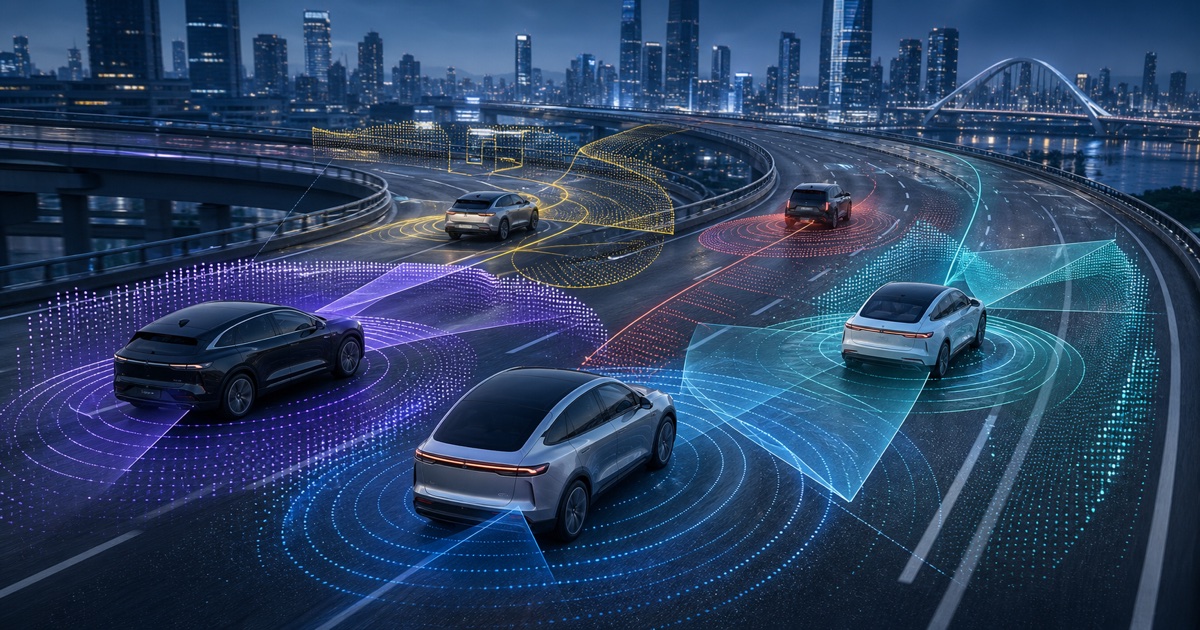
Unlike the big OEMs in Europe, the US and Japan, which move slowly on autonomous driving, EV makers tend to push the hardware and software into production far more aggressively. In the Chinese market especially, once the new car companies have piled up every spec they can, the only thing left to differentiate on is in-house autonomous driving hardware and software.
Hardware
The table below is sorted by 2022 sales (only carmakers with a clear plan to ship autonomous driving are listed; some newer brands are not counted)
| OEM | Solution | Production | Source |
|---|---|---|---|
| BYD | NVIDIA / Horizon Robotics | 2023 | 1 2 |
| SAIC-GM-Wuling | DJI | 2022 | 1 |
| Tesla | In-house FSD | 2019 | 1 |
| Xpeng | NVIDIA | 2020 | 1 |
| Li Auto | NVIDIA / Horizon Robotics | 2022 | 1 2 |
| NIO | NVIDIA | 2022 | 1 |
| BAIC Arcfox | Huawei | 2022 | 1 |
| Geely Zeekr | Mobileye | 2021 | 1 |
| Changan Avatr | Huawei | 2022 | 1 |
| SAIC IM Motors | NVIDIA | 2022 | 1 |
| SAIC Rising Auto | NVIDIA | 2022 | 1 |
What the table shows is that the vast majority of carmakers buy the hardware and write the software themselves, and the hardware specs line up closely:
- Compute at the 500 TOPS level
- One or more forward-facing lidars
- One or more millimeter-wave radars
- 4 to 6 surround-view cameras (3MP+)
- Multi-focal-length or stereo front cameras (8MP+)
- Ultrasonic sensors around the body
- GPS/IMU
Tesla is the exception and sticks to a vision-only solution. From first principles, vision alone can indeed reach full autonomy (the same way a human driver does). But a vision-only approach depends heavily on progress in machine learning research and needs matching compute for both inference and training, which makes it the hardest path to walk.
Software and Algorithms
But is maxing out the hardware enough? Among these domestic OEMs, apart from a very few new car companies with internet DNA that have some software capability, the vast majority are badly short on software development. At this stage most of them bring in an algorithm supplier to develop jointly, and Huawei, DJI and Mobileye also offer what amount to black-box solutions.
Open Platform or Black Box?
The head of SAIC once made some remarks about the "OEM's soul". It is not hard to see from them that software-defined vehicles are where things are going, and OEMs already understand clearly that software and algorithms are the core of the future car industry. That raises a key question: will the future car industry run on each company's proprietary solution, or will it embrace some open platform?
- For an aggressive carmaker like Tesla, it is hard for any third-party solution to meet their requirements. The only way out is to build everything in house, hardware and software, ending up with a closed product much like Apple's.
- For traditional OEMs just stepping into autonomous driving, choosing an open hardware platform or a black box depends on how determined they are to build software in house. Taking a complete solution from Huawei or DJI can greatly shorten the time from design to volume production to market, which helps in getting there first.
- New car companies like NIO, Xpeng and Li Auto are more determined to differentiate on autonomous driving. With software and algorithm teams of a reasonable size, they usually pick an open hardware architecture such as NVIDIA's and build their own software stack from scratch, ending up with a software moat of their own.
Outlook
As high-compute automotive chips and automotive-grade lidar spread, L2+ autonomous driving will land across the board in 2024 and 2025. A bold guess: whoever wins that moment in the Chinese market, OEM or supplier, will hold a long-term advantage for the next ten or even twenty years.